
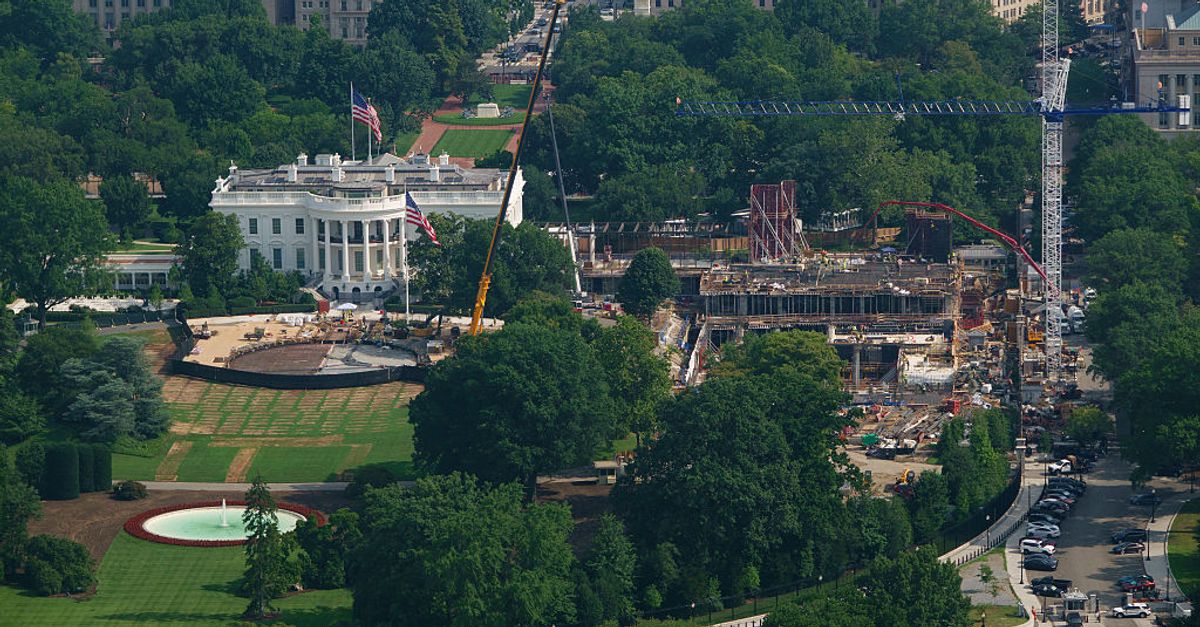
White House ballroom construction is now before the Supreme Court, with the Trump administration seeking to keep work on the new East Wing facility moving while a legal challenge continues in lower courts.
The application to the justices was filed on Friday, one week after a federal appeals court in Washington affirmed a district court order that temporarily barred above-ground work on the project while granting the government 14 days to seek Supreme Court review.
In filings, U.S. Solicitor General D. John Sauer asked the court to pause the order by Senior U.S. District Judge Richard Leon, calling it “extraordinary and unlawful.” Sauer argued the injunction would stop progress on an integrated security complex that includes a fully secure ballroom in the White House’s East Wing, which he said is required for national security. He requested an immediate administrative stay as well as a stay pending the government’s forthcoming petition for review.
White House ballroom construction at center of preservation suit
The dispute began in October 2025 when the administration demolished the East Wing, formerly home to the First Lady’s offices, to build a roughly 90,000-square-foot ballroom, a footprint just under one and a half football fields.
The National Trust for Historic Preservation, a private nonprofit focused on safeguarding historic sites, sued in federal court in Washington, D.C., to halt the project.
Judge Leon’s order would have blocked above-ground construction of the ballroom but permitted underground work, including bomb shelters and bunkers, and any above-ground activity necessary for safety and security. That order never took effect because the U.S. Court of Appeals for the District of Columbia Circuit issued an administrative stay during the government’s appeal.
On Aug. 7, a divided three-judge panel of the D.C. Circuit upheld Leon’s ruling. Judges Patricia Millett and Bradley Garcia concluded that Congress, not the president, holds exclusive authority over construction and demolition of White House structures and has not appropriated funds for the ballroom. They also agreed with the National Trust that allowing construction to continue risked permanent harm to its members due to irreversible historical, architectural, and visual damage.
Judge Neomi Rao dissented, asserting that the National Trust lacked standing to sue and contending that the president has authority to make improvements to his residence, which could include the ballroom.
Government challenges standing and asserts presidential authority
The appellate majority stayed its decision for 14 days to allow the administration to seek Supreme Court intervention. In his application, Sauer argued the trust lacks standing because its claims rely on a member’s dislike for the project, which he said is a subjective preference rather than a legal injury. He pointed to a declaration from Joshua Fisher, director for White House Management and Administration, stating the building is already being lauded as one of the most beautiful of its kind in the country.
Sauer also disputed the conclusion that the president lacked authority to proceed, writing that Congress has twice authorized the project by permitting presidents to make alterations and improvements to the White House and by broadly empowering the Executive Branch to construct buildings in national parks.
The filing said Leon’s order has never taken effect, so construction has continued with a 250-person crew working 20 hours a day, seven days a week, keeping the project ahead of schedule and under budget. According to the government, the project is 65 percent complete and progressing toward total completion.
Fisher added that if the court were to order the building taken down or altered, it would be effectively impossible to do so, noting the use of concrete of the type used in nuclear power plants that is virtually impossible to deconstruct.
The Supreme Court directed the National Trust for Historic Preservation to respond to the government’s request by 12 p.m. EDT on Tuesday, Aug. 18.
The Supreme Court direction to respond echoes other high-profile matters on the Court’s docket, including upcoming Supreme Court November arguments that have drawn national attention.
Updated on Aug. 14 at 2:01 p.m.