
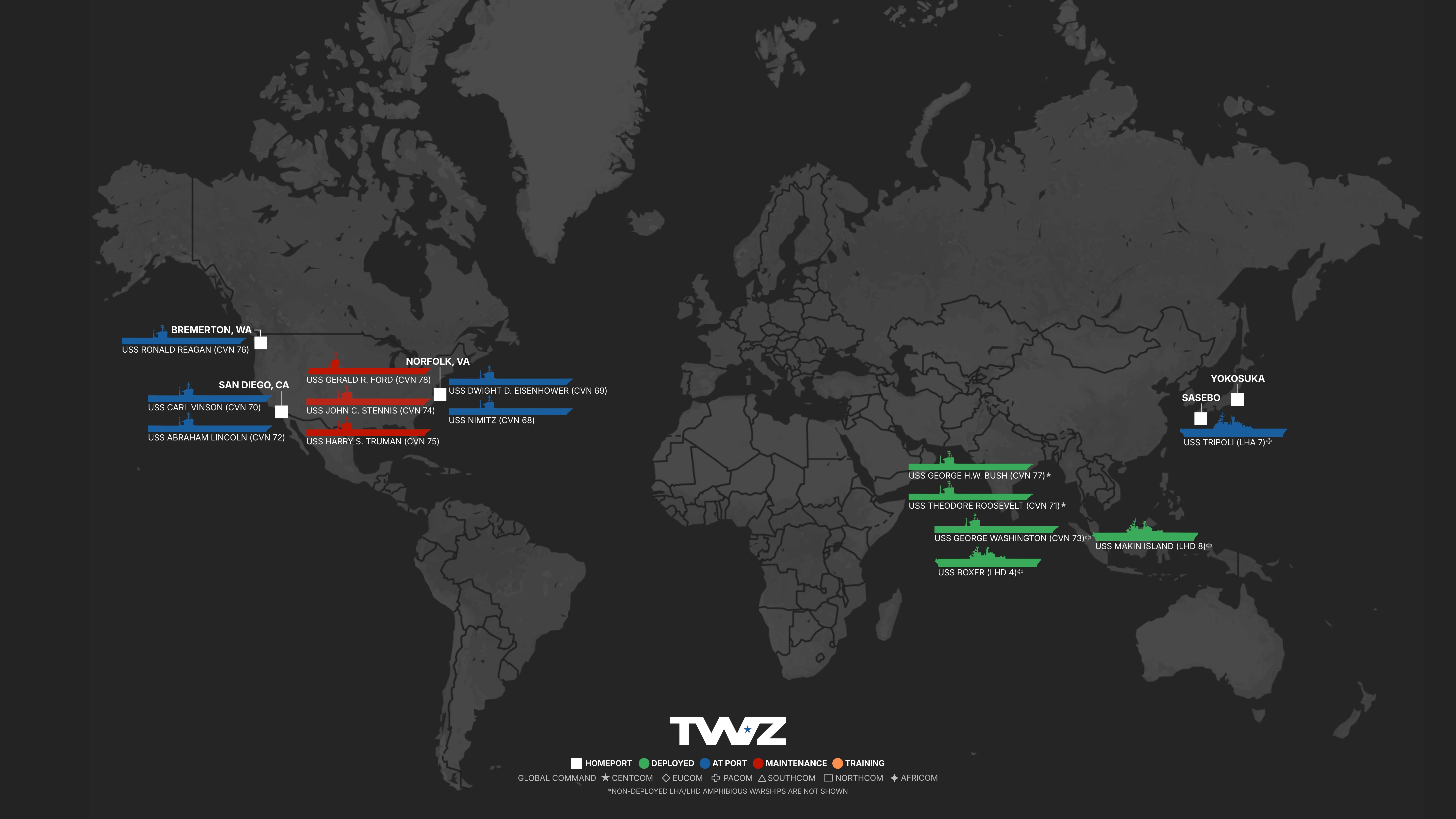
USS Theodore Roosevelt entered the U.S. 5th Fleet and U.S. Central Command area of responsibility this week, sailing alongside USS George Washington in the Arabian Sea as the Navy executed a planned relief. With USS George H.W. Bush already on station, the brief overlap placed three American carriers in the region before Washington departed, according to officials. Carrier posture in the Middle East now returns to two flattops.
At the same time, the final elements of the Abraham Lincoln Carrier Strike Group returned home after lengthy deployments. Amphibious assault ship USS Boxer has left the Middle East, while her expected replacement, USS Makin Island, is in Singapore. In separate remarks to senators, the acting secretary of the Navy said the service anticipates five years operating with nine carriers rather than the 11 required by law.
Editor’s note: This weekly carrier tracker compiles open-source positions and status updates on deployed Carrier Strike Groups and Amphibious Ready Groups.
How Many Aircraft Carriers Are Still In The Middle East?
Theodore Roosevelt departed Singapore on November 8 after a short stay at Changi Naval Base, then crossed the Strait of Malacca and entered the CENTCOM area around November 15. Guided-missile cruiser USS Chosin and destroyer USS Decatur accompanied the carrier through the strait, while destroyer USS Paul Hamilton remained in the South China Sea. Destroyer USS Carl M. Levin has been disaggregated in the theater since October. It was not immediately clear if Levin has rejoined the strike group.
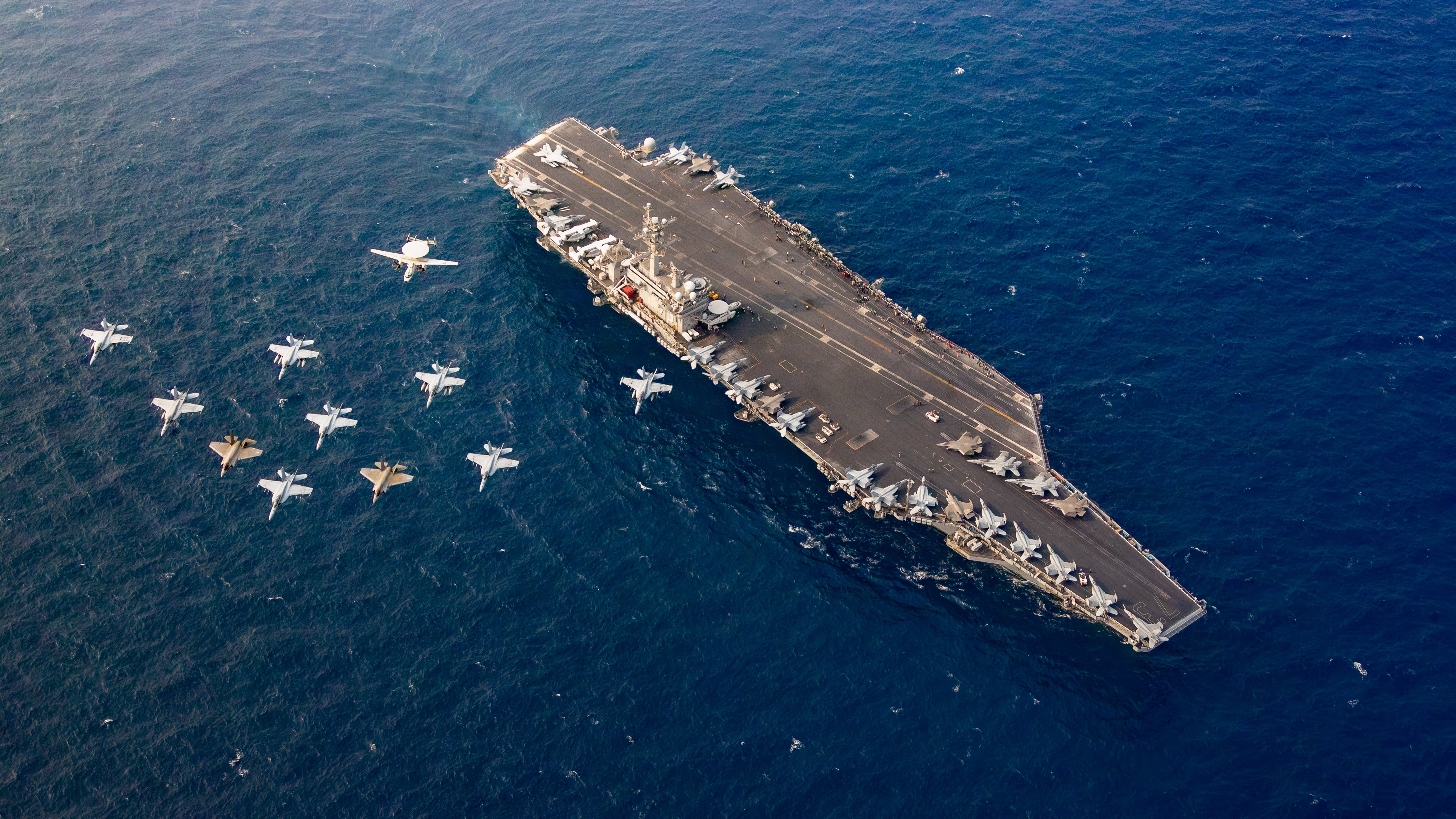
During the short three-carrier window, the combined air wings fielded 10 F/A-18E/F Super Hornet squadrons, two F-35C squadrons, and three EA-18G Growler squadrons. Washington and Theodore Roosevelt each embark a squadron of F-35Cs. George H.W. Bush operates Super Hornets and Growlers. The handoff maintains one F-35C squadron in theater.
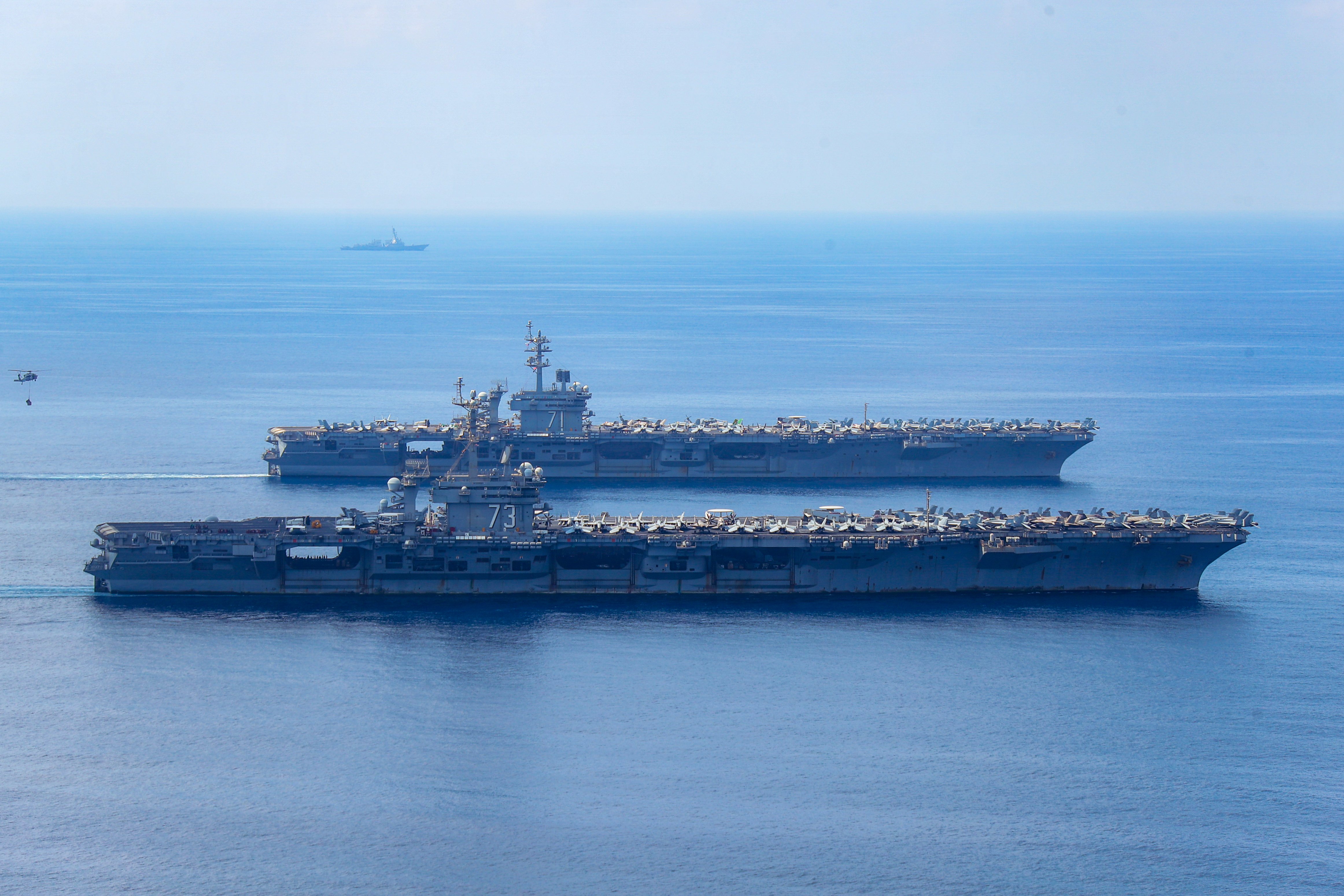
Washington left Yokosuka on May 23 for a routine Western Pacific patrol and was redirected to CENTCOM in August to relieve Lincoln. The carrier has now been deployed for 181 days, roughly twice the three-month patrol many Sailors expected at departure. The ship was most recently seen operating in the Indian Ocean in 7th Fleet and hosted visitors including U.S. Ambassador to India Sergio Gor.
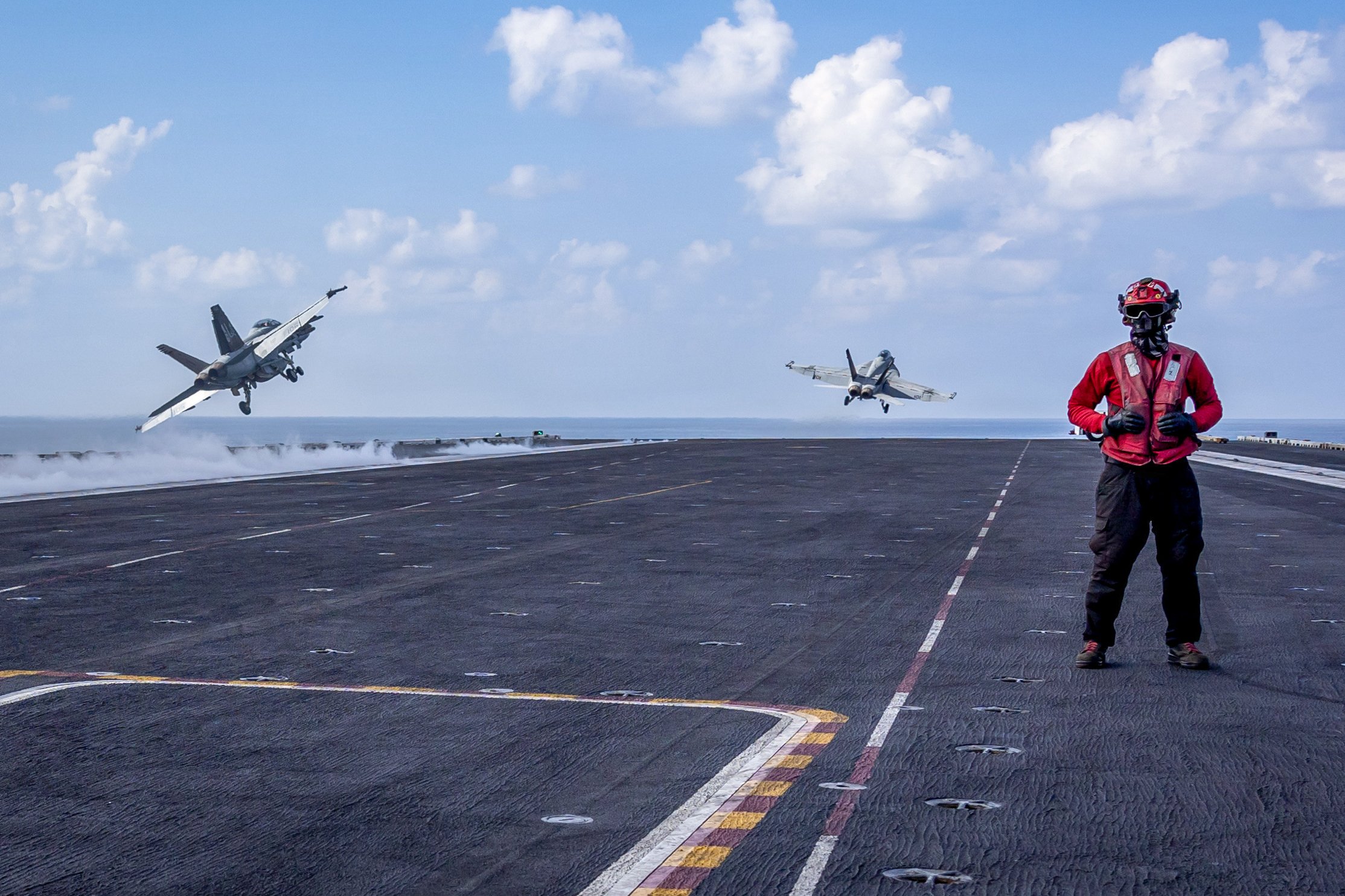
The maritime blockade of Iranian ports and coastal cities remains in effect. On November 7, a U.S. aircraft used precision munitions to disable the St. Kitts-flagged cargo ship M/V Huda in the Gulf of Oman, the fifth vessel disabled since July and the first in nearly a month. CENTCOM said about 150 additional ships have been redirected. Iran resumed attacks on U.S. bases between November 13 and 17, but U.S. officials reported intercepts with no damage or casualties. U.S. forces struck targets on Qeshm Island on Tuesday.
How Long Will USS George H.W. Bush Be Deployed?
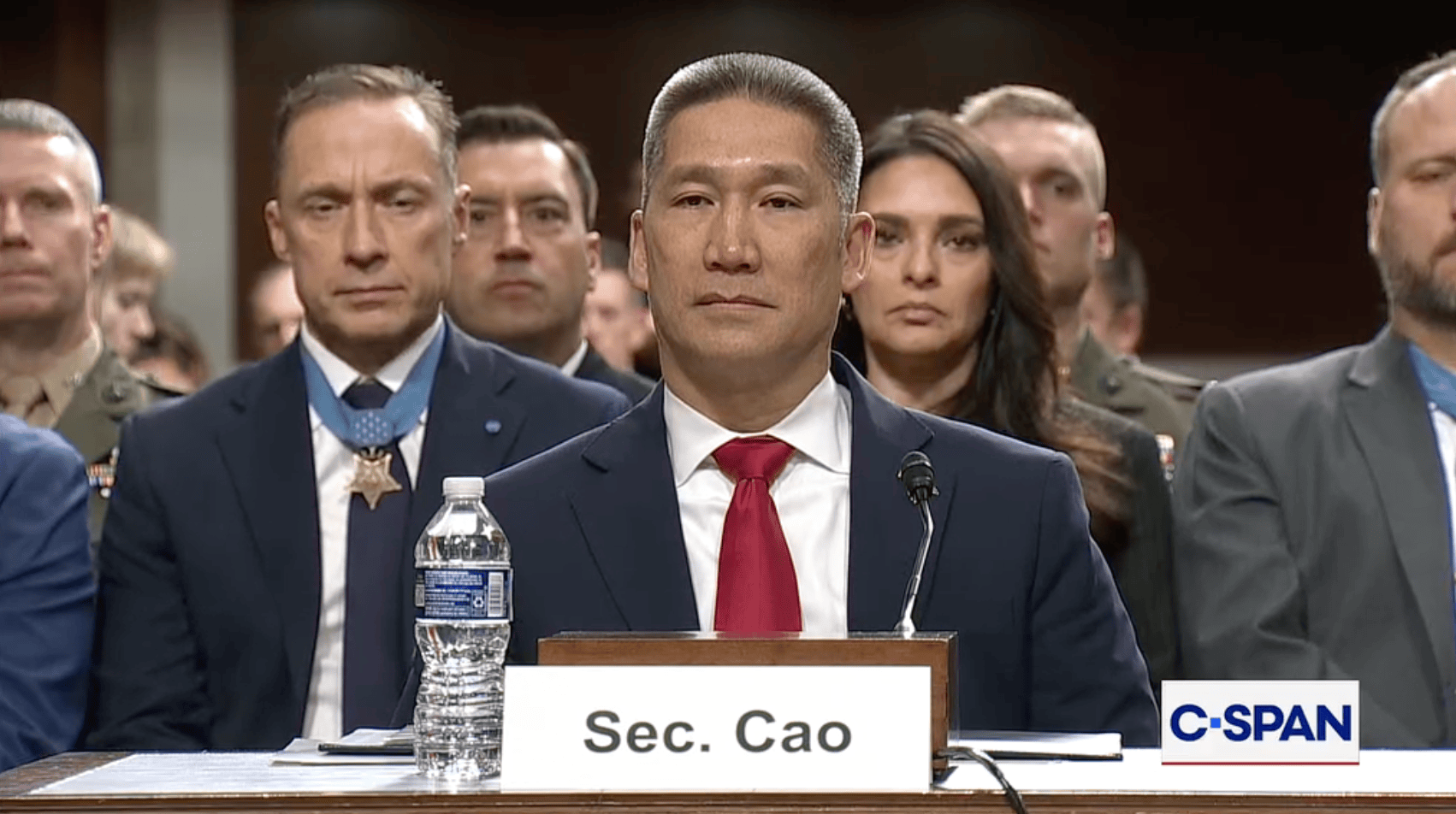
USS George H.W. Bush remains in theater. She is 234 days into a deployment that began March 31 from Norfolk. At a November 9 town hall, Navy leaders told about 500 family members to plan for a worst-case 12-month deployment, according to audio shared publicly. Asked what would trigger the strike group’s return, acting Secretary of the Navy Hung Cao said, “The criteria is for them to agree to a non-nuclear Iran.”
Officials told families the Navy is preparing USS Dwight D. Eisenhower to eventually relieve Bush, consistent with an early 2027 deployment timeline previously disclosed. A full year at sea would surpass the 326-day record set by USS Gerald R. Ford in May. On that schedule, Bush would pass the mark around February 21, 2027.
What Did The Navy’s Acting Secretary Tell Congress About The Carrier Fleet?
Cao told the Senate Armed Services Committee during his confirmation hearing that delays linked to Ford-class electromagnetic catapults and weapons elevators will leave the Navy with “five years where we’re going to be down to nine carriers,” two fewer than the 11 mandated by law. Committee Chairman Sen. Roger Wicker described a push to revert to steam catapults as a non-starter.
Cao placed the battle force at 286 ships and said 17 destroyers are supporting the Iran blockade. He added that unmanned surface vessel development is being accelerated to ease tasking demands. Sen. Mark Kelly cited family reports of food shortages aboard Washington and the Boxer Amphibious Ready Group. Cao acknowledged destroyer USS Gonzalez, most recently in the Red Sea, had about a week of rations at one point. Sen. Mazie Hirono questioned the concentration of three strike groups in the Middle East while leaving gaps in the Pacific.
Where Is The Rest Of The American Aircraft Carrier Fleet?
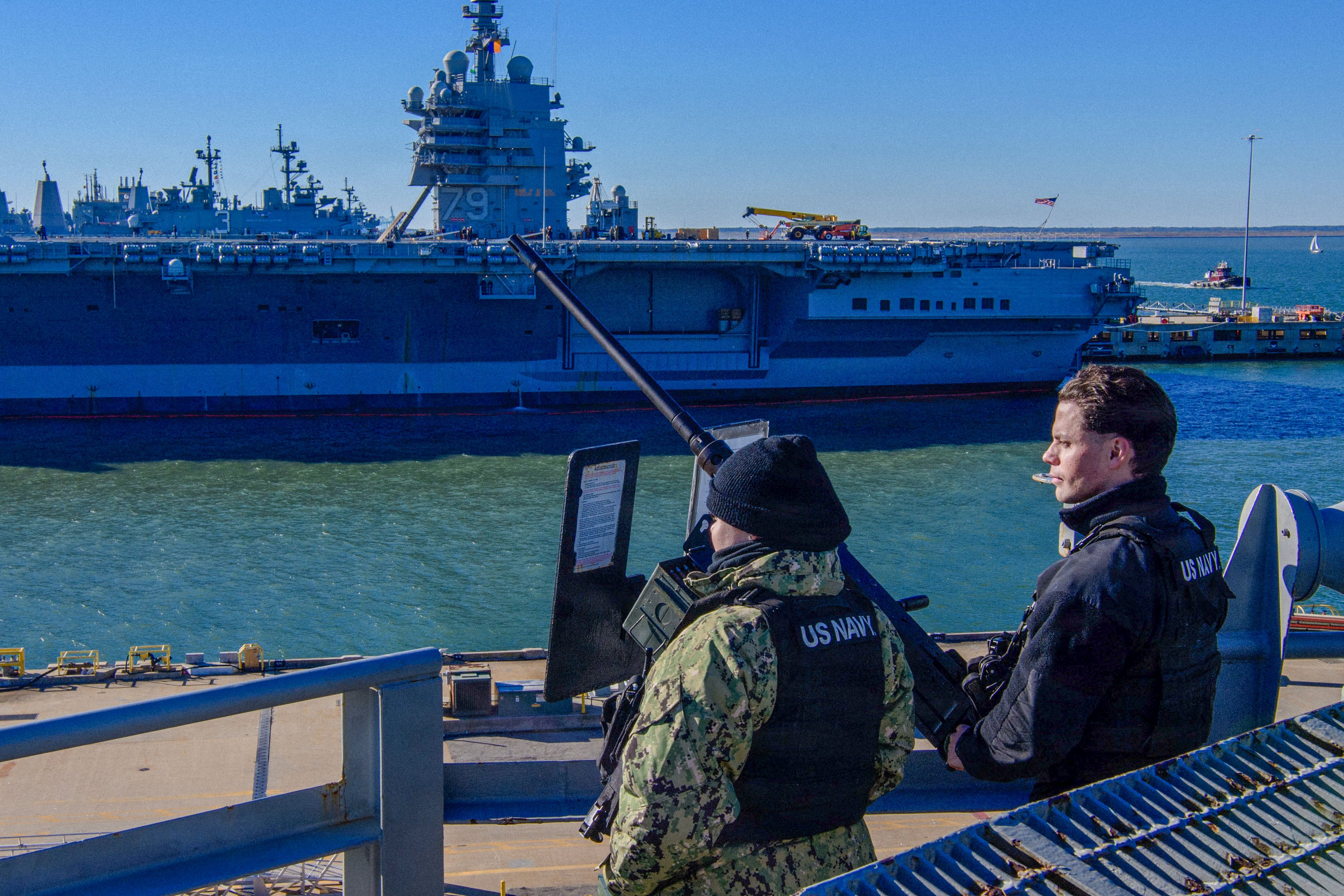
- West Coast: Abraham Lincoln is in San Diego ahead of a homeport shift to Bremerton, Washington, by year’s end. Her last escorts returned after historic deployments. Destroyer USS Michael Murphy reached Pearl Harbor on November 12 after 346 days, and USS Spruance arrived in San Diego a day later after 357 days, reportedly the longest destroyer deployment since World War II. USS Ronald Reagan is in Bremerton and USS Carl Vinson is in San Diego.
- East Coast: USS Nimitz returned to Norfolk after training, supporting Carrier Qualifications for CVW-1 and student naval aviators, totaling 103 sorties, 442 arrested landings, and 152 touch-and-goes, according to the Navy. Eisenhower is also in Norfolk.
- Maintenance: USS John C. Stennis is completing Refueling and Complex Overhaul, USS Harry S. Truman is beginning the same evolution, and Ford is in a Planned Incremental Availability slated through March 2027.
- Next-in-class: The future USS John F. Kennedy returned to Norfolk on November 5 after Aircraft Compatibility Testing and is scheduled for delivery in spring 2027.
The Big Deck Fleet At A Glance
In sum, three carriers are deployed, three are in workups, three are in maintenance, one is post-deployment and preparing for an upcoming availability, another is primarily supporting training before deactivation, and the next to be commissioned is slated to join the fleet in 2027. Two amphibious assault ships are deployed, one is forward-deployed, two are in port preparing for future deployments, and four are in maintenance.
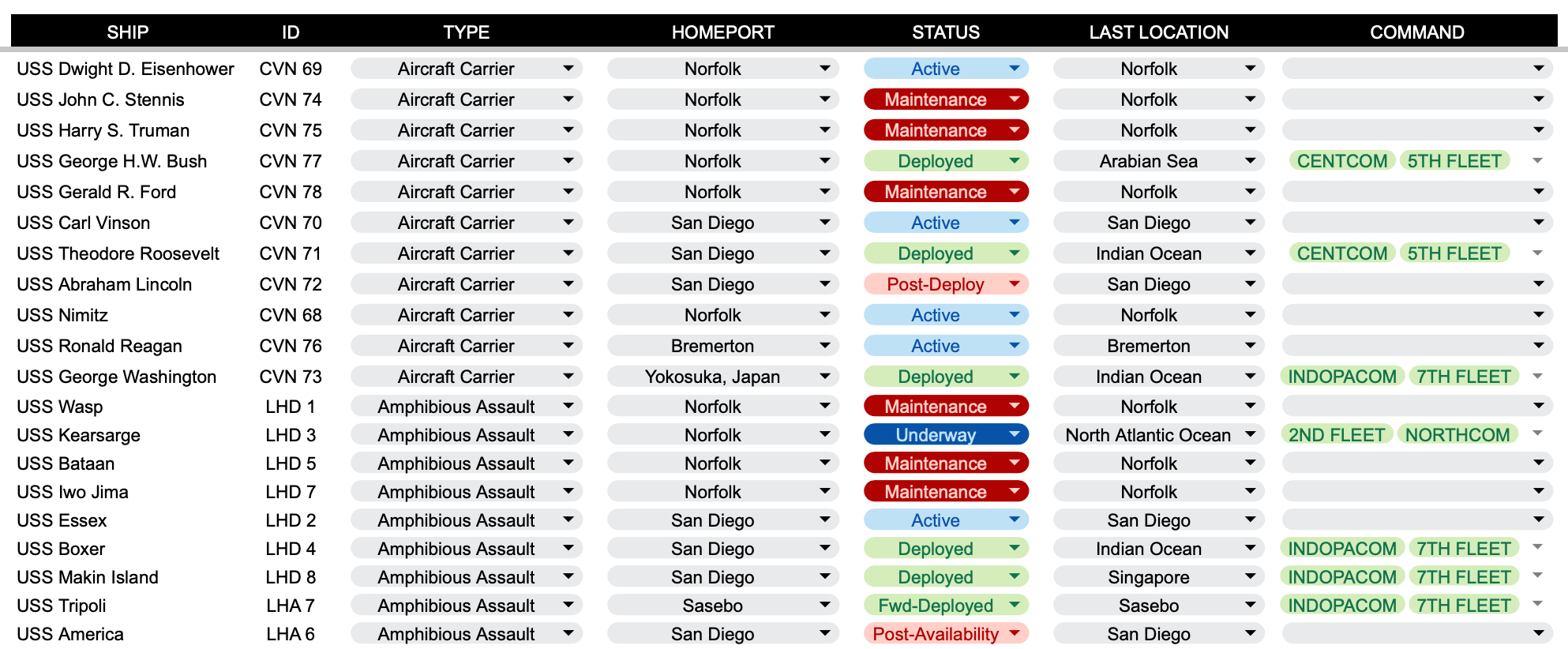
Note: Positions are general approximations. Non-deployed LHA and LHD amphibious ships are not depicted in the graphic.
For more on how future autonomous systems could integrate with the carrier force, see Navy Collaborative Combat Aircraft won’t wait for F/A-XX. Additional official information on deployed U.S. naval forces is available from the U.S. Navy.