
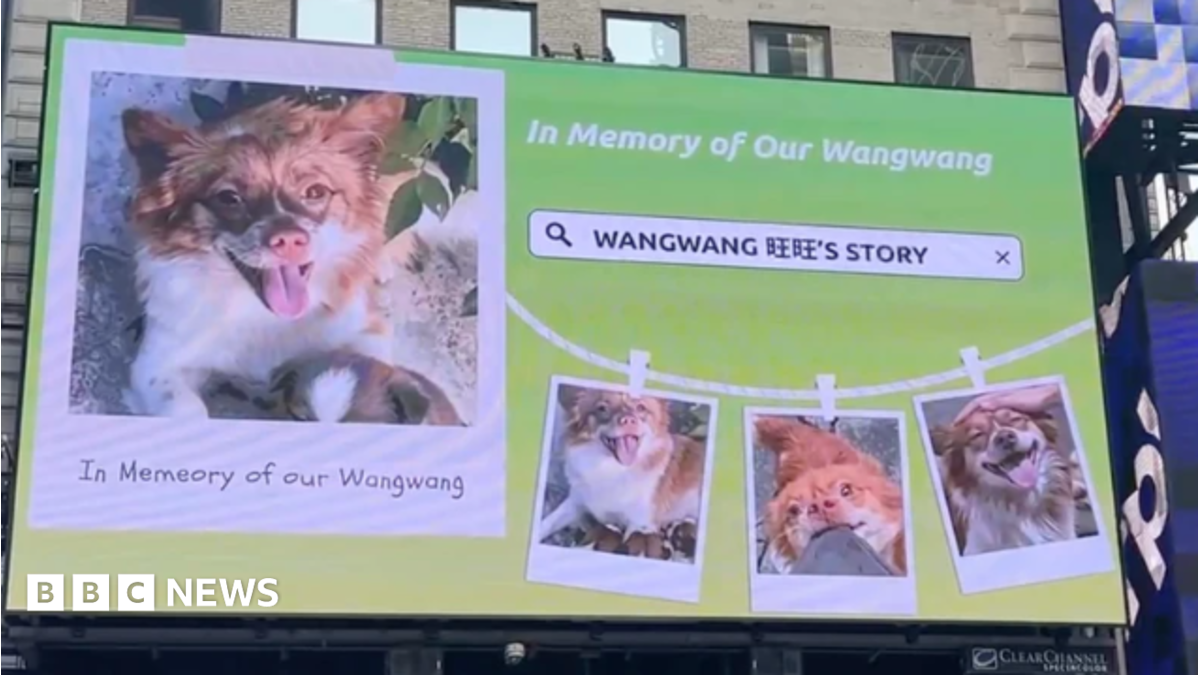
Wang Wang billboards have appeared in some of the world’s busiest public spaces, turning a Chinese animal cruelty case into a cross-border campaign that is spreading from social media to streets and stadiums.
In New York City’s Times Square, images of a dog named Wang Wang cycle onto a large digital screen roughly every 35 minutes. One message reads, “She was loved. She wanted to live. She should still be here.” A similar display has gone up near Taipei 101 in Taiwan, featuring Wang Wang nursing her puppies and the line, “This planet is their home too. Justice for Wang Wang.”
A Taiwanese woman identified as CK said she spent NT$30,000, about $930, on the Taipei billboard to foster “a sense of unity.” She said the aim is to show people are speaking out together rather than individually online, and she has opened accounts on platforms including Reddit and X to share updates on the animals’ plight. CK added that a video of the killing left her unable to sleep or eat for days.
Another Taiwanese supporter, Elara, used AI to translate a summary of the incident into more than 10 languages, including Japanese, Portuguese and Russian, which has been circulated online to broaden awareness.
Support has also come from residents in Hong Kong and Macau, who have raised funds for posters on buses and trains. Inside mainland China, discussion continues to build around the need for laws against animal cruelty and for wider public education.
During a domestic football match in Dalian on Saturday, a striking cartoon of Wang Wang and her puppies appeared on a stadium screen with the caption, “Every life deserves respect and kindness,” drawing attention from fans. Homegrown businesses have joined in as well. Beauty brand Amortals and streetwear label Wah Yan Ching Nin have placed ads outside shopping malls across the country urging an end to abuse.
Merchandise featuring Wang Wang and her puppies, such as stickers and car decals, has gone on sale on Taobao, China’s largest e-commerce platform, reflecting the campaign’s growing cultural footprint.
Some efforts have faced pushback. In Changsha, the Wan Jia Li mall was reportedly instructed to remove billboards featuring Wang Wang. An employee with the mall’s management said, “We can’t do animal-protection billboards anymore. My boss told me so. I’m not sure if the notice came from the government, or why we have been asked to take them down.”
Wang Wang billboards fuel sustained online momentum
Despite hurdles, supporters have kept up pressure online. Comments on Weibo urged continued posting to keep attention high, with one message saying, “Let’s keep posting. Don’t let the heat of discussion cool down.” Another read, “Constantly speaking up does not mean disturbing social order. [We’re doing this] to let more people see it and realise it’s such an important thing that we do not mistreat animals.”
For many activists, the goal is to turn public sympathy into concrete protections, keeping Wang Wang’s story visible at home and abroad, much as international attention followed tragedies such as the Lima house fire.