
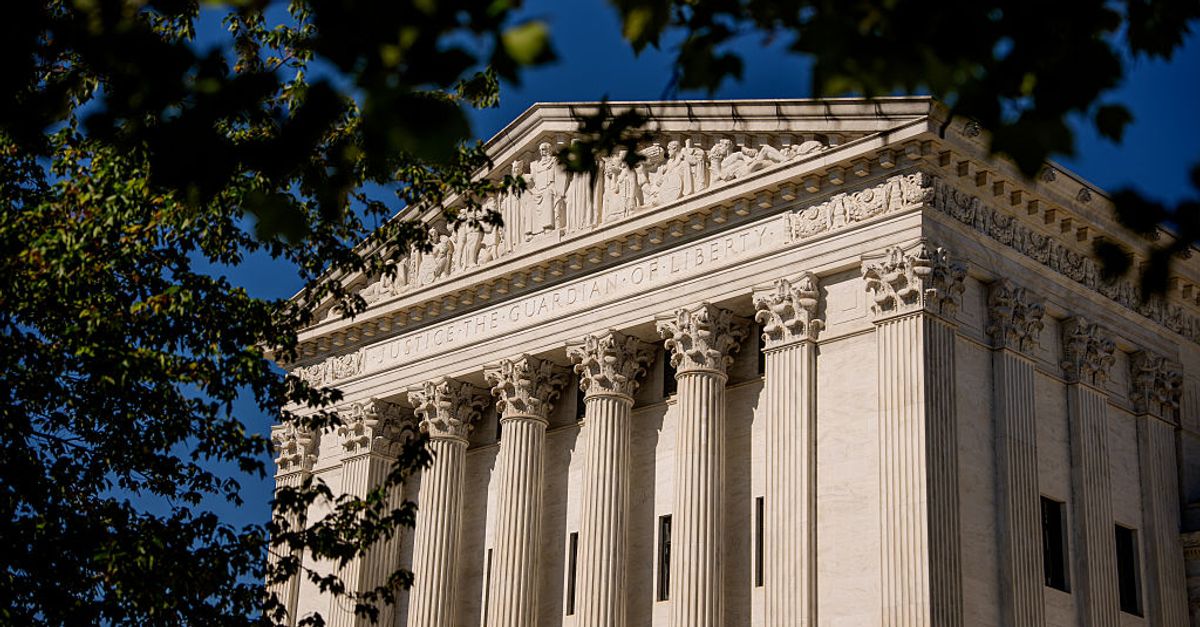
Twenty-three states and the District of Columbia asked the Supreme Court on Monday to leave in place a lower court ruling that restricts implementation of an executive order on mail-in voting for the November elections. In a 45-page brief, the coalition warned that pausing the order would allow the federal government to advance what they called an unprecedented voter verification and ballot interception plan that would expand the U.S. Postal Service’s authority.
President Donald Trump signed the executive order on March 31, 2026. The contested provisions direct multiple federal agencies to act.
One requires the Department of Homeland Security to compile lists of adult U.S. citizens in each state and transmit those lists to state officials at least 60 days before a federal election. A second instructs the U.S. attorney general to prioritize investigating and, where appropriate, prosecuting state and local officials who issue federal ballots to people not eligible to vote in federal contests.
A third requires states that conduct mail voting to give the USPS a list of eligible voters slated to receive ballots and prohibits the USPS from transmitting ballots to voters not on USPS-created rolls of enrolled voters.
The states, led by California, and the District of Columbia sued in federal court in Boston, arguing the order conflicts with constitutional provisions that leave voter eligibility to the states and empower states to set the times, places, and manner of congressional elections.
U.S. District Judge Indira Talwani found that some claims were not yet ripe for elections after Nov. 3, 2026. She ruled, however, that the immediate demands of the upcoming midterms created a direct and immediate dilemma for the plaintiffs.
Talwani barred the federal government from implementing the three provisions for the November 2026 elections in the 23 states and the District of Columbia that brought the challenge.
The federal government and a coalition of 12 states led by Alabama asked the U.S. Court of Appeals for the 1st Circuit to stay Talwani’s order. The 1st Circuit declined, noting that neither the federal government nor the 12 states defended the legality of the executive order.
The court also rejected arguments that the plaintiffs lacked standing or that the case was unripe, writing that the order’s consequences left states with no practical choice but to respond now.
Both the federal government and the 12-state coalition then asked the Supreme Court last week to pause Talwani’s ruling. U.S. Solicitor General D. John Sauer argued that the dispute is premature because agencies have not finalized implementation plans.
He added that a stay is warranted to avoid serious irreparable harm, writing that even if the agencies’ plans are ultimately lawful, there is not enough time to secure ordinary appellate relief and carry them out before November given the timelines for voter-roll verification and mail voting.
Sauer also sought an immediate administrative stay to freeze Talwani’s order while the justices consider the request. The court has not issued such a stay.
The 12-state group pointed to two recent decisions by the U.S. Court of Appeals for the District of Columbia Circuit involving the same executive order. One, they said, concluded it was too soon to challenge the order, and another allowed it to be reinstated on that basis.
Executive order on mail-in voting faces timeline and ripeness dispute
In their Monday filing, the states and the District of Columbia urged the justices to maintain what they described as a narrow injunction that prevents the federal government from implementing its new voter verification and ballot interception program this year in the jurisdictions that sued.
They countered arguments that they lack a right to sue or that the dispute is unripe because the order is not fully implemented. Citing the appellate panel below, they said the order’s detailed timelines and the inescapable legal requirements and impending deadlines for mail and absentee voting create a concrete injury that permits suit.
They added that if they cannot challenge the order now, it would be extremely difficult, if not impossible, to obtain a definitive ruling in time to redesign and reorder ballot mailings, train election officials, and inform voters before the November midterms.
The coalition’s request comes as other challenges involving the same executive order continue to reach the high court, including a separate Supreme Court mail-in voting restrictions bid by Trump that raises related questions about federal authority over elections.
Key federal actors named in the order, including the Department of Homeland Security, the U.S. Postal Service, and the U.S. Department of Justice, have not yet finalized their implementation plans.