
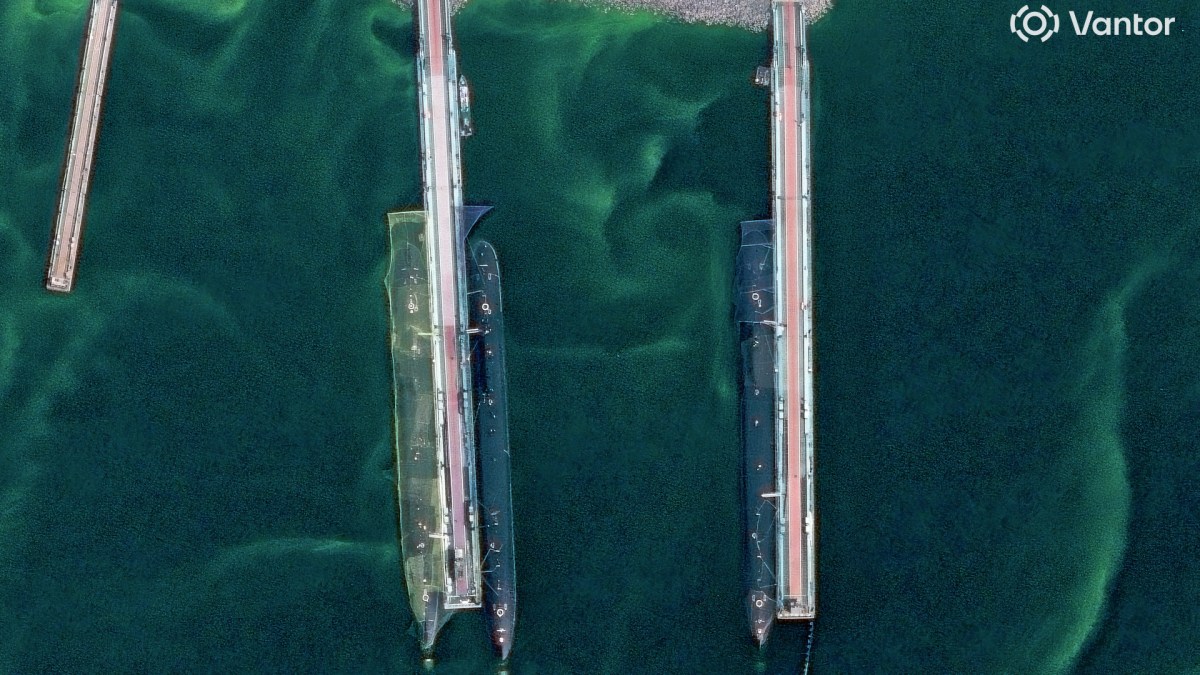
New satellite imagery indicates the deployment of Russian submarine nets at a strategic base on the Kamchatka Peninsula, with additional counter-drone measures observed at a Black Sea facility. The appearance of these defenses suggests Moscow is hardening critical naval assets against uncrewed threats far from the front lines.
Imagery provided by Vantor shows netting placed over submarines at the Russian Navy’s base at Rybachiy in Kamchatka, according to analysts. The base serves as the principal homeport for Borei and Borei-A class nuclear ballistic missile submarines, as well as other guided missile and attack submarines assigned to the Pacific Fleet.
Vantor imagery dated August 4 shows multiple submarines fully covered by nets, a setup consistent with countermeasures Russia has adopted against one-way attack drones targeting assets on land and at sea. Similar protective netting has been employed by other militaries worldwide.
Additional Vantor imagery suggests the Russian Navy began installing these nets in May. Pictures from May and August show crane barges positioning supports and rigging around submarines at their moorings.
Floating booms are also visible encircling Rybachiy’s piers, a now routine measure at Russian naval bases that adds another barrier against surface-borne threats, particularly explosive-laden uncrewed surface vessels.
Russian submarine nets and Black Sea countermeasures
On Tuesday, the United Kingdom’s Ministry of Defence released additional Vantor imagery of the Russian Navy’s Novorossiysk base on the Black Sea, taken June 13. The images show several Kilo class attack submarines partially submerged in port, with three boats fitted with anti-drone armor screens over their conning towers. A review of commercial satellite archives suggests these screens were a relatively new addition at that time.
British officials said three of four Kilo class submarines had counter-UAS cages installed as a preventive measure in response to Ukraine’s expanding strike reach. They noted the boats had loosened moorings and submerged within the basin, leaving conning towers above the waterline, which explained the need for the cages.
The same assessment said a fourth submarine without a counter-UAS cage also submerged after moving away from nearby surface vessels, adding that the absence of a cage likely indicated a lower priority for that hull.
Vantor imagery from June 17 shows the submarines surfaced and back at their moorings, raising questions about whether the earlier submergence was triggered by a perceived threat or part of a readiness drill. Either scenario underscores shifting force protection postures at the base.
Uncrewed aerial systems and uncrewed surface vessels have already prompted sweeping defensive upgrades at Russian naval and other military sites, especially those nearer to Ukraine. In 2024, satellite imagery of Novorossiysk showed a painted submarine silhouette and a mock conning tower on a pier, part of efforts to defeat munitions guided by autonomous image-matching.
That same year, what appeared to be overhead protection against drones was observed on the Delta-IV class nuclear ballistic missile submarine Tula at Gadzhiyevo in the Murmansk region. Those early fittings were rudimentary compared with the more extensive screens now seen at Novorossiysk and the Russian submarine nets erected at Rybachiy. Similar counter-drone structures have since been fitted to other Russian naval vessels.
Ukraine continues to expand the range and diversity of long-range one-way attack drones and cruise missiles, striking targets across western Russia, including near Moscow, on a near-daily basis. Ukrainian uncrewed surface vessels regularly patrol the Black Sea, and Novorossiysk and sites in occupied Crimea have been among frequent targets.
Kyiv has also fielded USVs capable of launching uncrewed aerial systems, adding additional attack vectors, and long-range drones with miniaturized satellite communications terminals capable of engaging moving targets at sea.
The spread of these threats is not limited to long-range strikes. Ukraine’s Operation Spiderweb last year demonstrated the risks of near-field attacks launched from within Russian territory, with bases in the country’s far east among those targeted. Ukrainian forces have also targeted Russia-linked vessels in the Mediterranean.
Concerns over uncrewed threats have extended beyond the immediate conflict zone. This week, an explosive-laden quadcopter was discovered next to a Ukrainian An-124 cargo aircraft at a German airport. U.S. officials assessed the drone belonged to a Russian intelligence service, according to reporting, following a series of drone incursions over military sites and critical infrastructure across Western Europe.
Drones have also been central in conflicts involving Iran and in other recent crises across the Middle East. With low barriers to entry and increasing capability among state and non-state actors, uncrewed threats are proliferating globally.
U.S. authorities have prioritized counter-drone defenses for domestic installations and overseas forces, though significant gaps remain. The Pentagon has explored a range of solutions, including systems like those described as the U.S. Army seeks counter-drone missile under $150,000.
Taken together, the counter-drone nets over submarines at Rybachiy and the protective screens and procedures at Novorossiysk reflect immediate pressures from Ukraine and a broader global trend. Comparable force protection measures are likely to appear elsewhere as militaries adapt to a rapidly evolving uncrewed threat environment.