
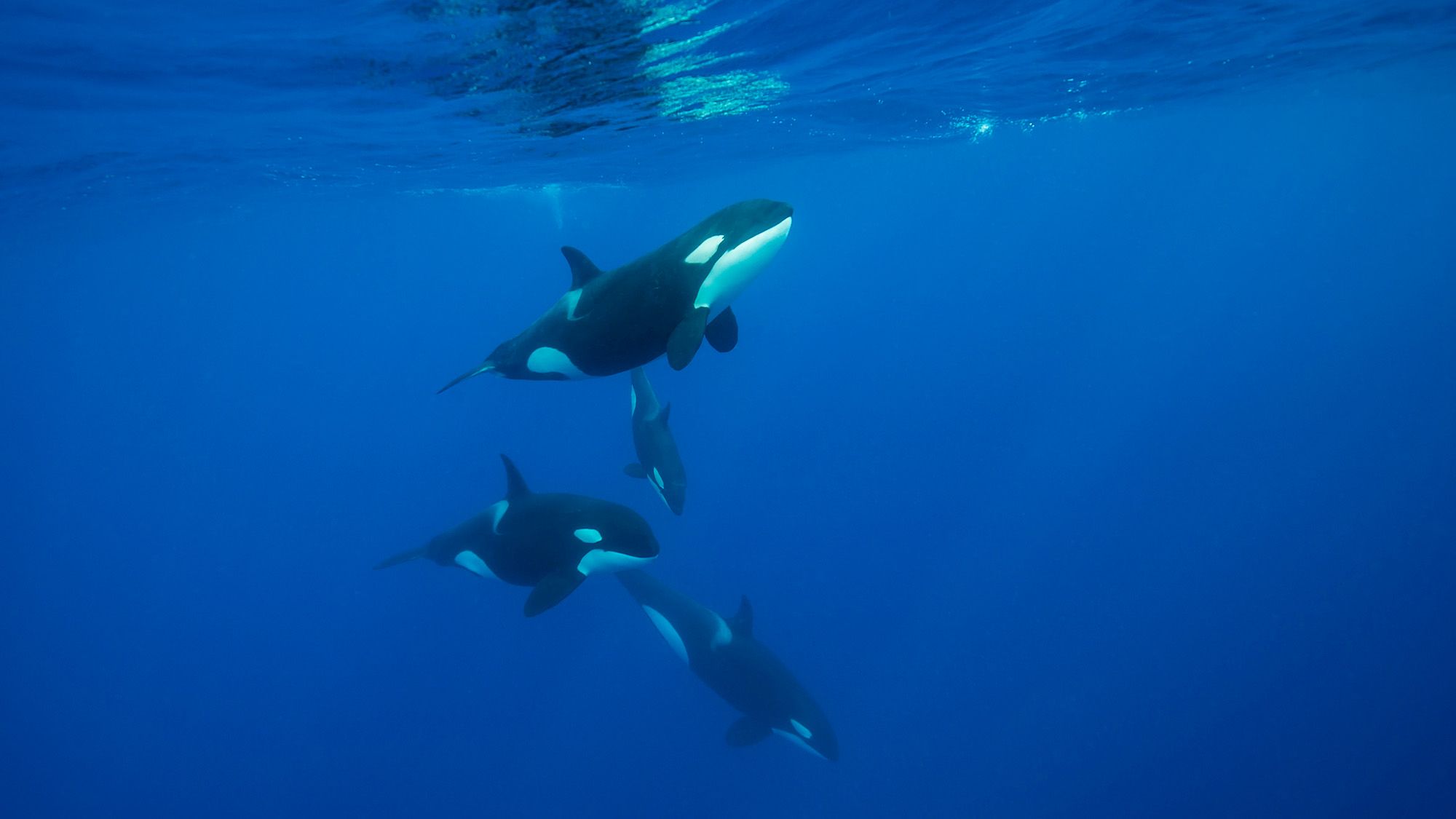
In the Gulf of California, researchers observed a striking behavior as orcas ram sunfish to break apart their carcasses, a possible food-processing tactic that appears to make it easier for younger whales to eat the bulky fish.
In two separate encounters, one killer whale held a sharp-tail sunfish (Masturus lanceolatus) while another orca accelerated toward it. Just before impact, the holder released the already dead fish, allowing the ramming whale to hit at speed and scatter flesh through the water, according to the research team.
“It was unlike anything I’d witnessed before,” said Kathryn Ayres of the conservation nonprofit Beneath the Waves, who filmed one of the events. She added that seeing such behavior unfold in real time was scientifically thrilling.
Ayres and colleagues labeled the behavior “ram-to-fragment.” Their report, published July 23 in Frontiers in Ethology, concludes the whales were not attempting to kill the sunfish, which were already dead and appeared disemboweled. Instead, the orcas likely fragmented the carcasses so group members, particularly juveniles, could feed more efficiently.
Hunting in action: orcas ram sunfish
The first documented event occurred in July 2024 near an offshore seamount off Baja California Sur, Mexico. An adult female gripped the sunfish by its clavus, or rudder-like tail, while an adult male approached belly-up at speed. The female released the fish an instant before collision.
The impact produced a loud sound and caused the tissue to fragment. In the video, Ayres can be heard exclaiming in surprise. A juvenile then moved into the cloud of suspended pieces to feed, while adults consumed the remaining larger sections.
A second encounter, filmed by diver Héctor Franz in September 2025, followed a similar sequence. One adult stabilized the sunfish, another rammed it, and a calf later pulled tissue from the disrupted carcass, the researchers reported. Ayres noted she had seen orcas hunt ocean sunfish (Mola mola) and ram prey before, but not with an impact that completely fragmented tissue.
The coordinated maneuver resembled interactions her team previously documented with whale sharks (Rhincodon typus) in the Gulf of California, where orcas took turns ramming the much larger fish.
Why fragment the fish?
Ramming is a known killer whale hunting method, said Matt Hansen, a postdoctoral researcher at the Leibniz Institute of Freshwater Ecology and Inland Fisheries who was not involved in the study. The hold-and-release sequence that shatters carcasses may be new, he added.
The authors propose that adults were processing food for younger whales. Orcas often tear prey into portions and share with calves and juveniles, and young animals were present during both events. However, Heather Hill, a professor and chair of psychology at St. Mary’s University in Texas who was not involved in the research, cautioned that two observations are insufficient to prove deliberate feeding or teaching.
“Whether it represents parental investment, observational learning, or resource distribution remains circumstantial,” Hill said.
The team also considered play. Orcas are highly intelligent and social, and they sometimes manipulate or strike prey without immediate feeding. Hill said these two sequences looked more functional than playful, noting that the single, decisive strikes were inconsistent with the varied repetitions typical of play.
The authors raised a more speculative idea that dispersing the sunfish’s microbe-rich skin and gelatinous tissue could influence the surrounding water or expose orcas to beneficial microbes, though any advantage is unclear. Hansen questioned how dispersing tissue into the water column would differ from eating it, while acknowledging the behavior highlights the ocean’s complexity.
The study is cited as: Ayres KA, Gallagher AJ, Avena CV, Duarte CM and Higuera Rivas JE (2026) Fragmentation of sharp-tail sunfish (Masturus lanceolatus) caused by high-impact ramming behavior in orcas (Orcinus orca). Frontiers in Ethology 5:1835536. doi:10.3389/fetho.2026.1835536.
Related research into ancient ecosystems, such as Triassic wildfires fueled by fern savannahs in Europe, also underscores how environmental conditions shape animal behavior over time.