
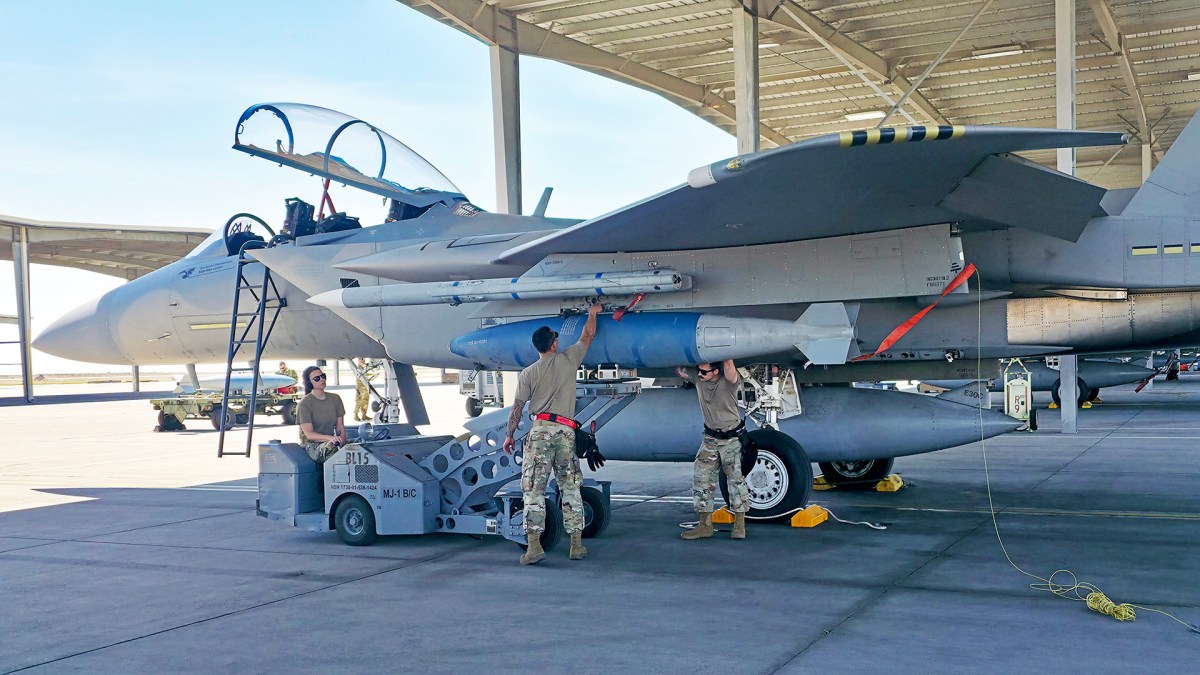
The main job of the U.S. Air Force’s growing fleet of F-15EX Eagle IIs has been and continues to be air-to-air combat, especially in defense of the U.S. homeland. However, operational and test units are laying the groundwork for F-15EX air-to-ground missions.
Expanding F-15EX air-to-ground missions
Despite its primary mission set, air-to-ground capabilities are inherently a part of the F-15EX’s design. The Eagle II is part of the broader F-15E Strike Eagle lineage and traces its configuration to the F-15QA variant developed for Qatar.
Last week, the Oregon Air National Guard’s 142nd Wing said one of its F-15EXs released training bombs for the first time during a visit to Mountain Home Air Force Base in Idaho in May. The 142nd, based in Portland, Oregon, remains the service’s only operational Eagle II unit.
“The crew dropped a total of 24 BDU-50s and 12 BDU-56s over 10 missions with zero safety incidences and satisfactory scores,” according to an official release. “These ‘bombs’ were loaded onto the F-15 EXs and dropped in the Mountain Home firing range complex.”
The BDU-50/B and BDU-56/B are inert training rounds that mirror the form and mass of live 500-pound-class Mk 82-series and 2,000-pound-class Mk 84-series bombs, respectively. Today, munitions in the Mk 82 and Mk 84 families are most often paired with Paveway laser kits or Joint Direct Attack Munition GPS-aided kits.
These training bombs remain valuable for honing general unguided release skills for aircrews and for ground teams practicing weapons handling. That includes target designation procedures, safe release checklists, and loading and unloading on the flight line.
Back-to-basics training is particularly important for the 142nd, which previously flew F-15C Eagles with no operational air-to-ground capability. It is also a shift from a single-seat platform to the two-seat F-15EX. The Air Force’s plan, at least initially, has been to employ a single pilot in the Eagle II, a point that could evolve as missions expand.
The 142nd does include personnel with prior air-to-ground experience, but the mission is new for the wing overall and demands dedicated training pipelines.
According to the release, three pilots from the 142nd completed a nine-month course on weapons employment and tactics and were tasked to design a syllabus to qualify the rest of the wing’s pilots on the basics required to drop munitions. Earlier this year, weapons loaders from the wing traveled to Nellis Air Force Base, Nevada, where they worked with F-15Es assigned to the 59th Test and Evaluation Squadron to certify on bomb loading.
The Air Force’s Test and Evaluation community has been validating the Eagle II’s air-to-ground functions for some time, and that work now includes events overseas. Earlier this month, the 85th Test and Evaluation Squadron brought an F-15EX from Eglin Air Force Base, Florida, to Kadena Air Base, Japan, for a munitions load training event alongside an F-15E. Photos released Monday show live GBU-53/B Small Diameter Bomb IIs, also known as StormBreaker, among the ordnance loaded for training.
Two active-duty F-15EX squadrons are slated for Kadena, replacing units that had operated F-15Cs there. In the interim, the Air Force has been rotating F-15Es and other fighter types through the base.
The service has also announced plans to field Air National Guard F-15EX squadrons in California, Louisiana, and Michigan. Its proposed Fiscal Year 2027 budget calls for a substantial expansion of the Eagle II fleet, potentially growing to a dozen or more squadrons. How this may alter employment concepts remains to be seen.
In its Fiscal Year 2027 budget request, the Air Force reiterated that “the F-15EX aircraft will be used predominantly in defensive and offensive counter-air missions at both Air National Guard (ANG) and Air Combat Command (ACC) operational squadrons.” It also said the “F-15EX will perform the Homeland Defense mission and provide Combatant Commanders (CCDR) with strike packages capable of operating in Highly Contested Environments (HCE).”
It has long been expected that the Eagle II would assume broader multi-role duties after entry into service despite the air-to-air emphasis. That prospect raises the possibility of employing Weapon System Officers, another pilot with multi-role skills, or a mission specialist in the rear cockpit, similar to the F-15E.
“We currently don’t have conformal fuel tanks [CFTs] for it [the F-15EX], but there is a plan to get us conformal fuel tanks. And then when we do, we can start talking about putting all kinds of air-to-ground capabilities into the airplane, potentially putting WSOs or other experts in the backseat as well to have us do any number of multi-role capabilities that it’s just physically not possible to in the C model,” then-Col. Michael Kosderka, who led the 142nd at the time, said in a 2024 interview. “So the X has tremendous growth capability. It’s really exciting.”
The F-15EX can accept the same CFTs used by the F-15E, adding fuel and additional hardpoints. The current status of CFT procurement for the 142nd’s aircraft is unclear. Its first two jets arrived without CFTs, and imagery from the May training at Mountain Home shows at least one aircraft still without them. Test-configured Eagle IIs typically fly with CFTs.
“Basically, what it’s going to do is turn a wing with a primary mission that is on life support, frankly, into something that has America’s newest fighter, and we’re going to be relevant with that airplane for decades to come,” Kosderka said.
“Gen. Kelly made it very clear in his public address here that the F-15EX is going to have an inherent capability that we need to put to work from day one, to include limited air-to-ground capability,” Lt. Col. Robert Waller, then commander of the 40th Flight Test Squadron at Eglin Air Force Base, said in a separate 2024 interview. He was referring to then-Air Combat Command chief Gen. Mark “Grace” Kelly, now retired.
These steps align with the Eagle II’s core strengths, including long range and the ability to carry heavy and outsized loads, spanning both air-to-air and air-to-ground weapons. Those attributes have made the F-15E one of the Air Force’s most in-demand platforms.
Strain on the aging Strike Eagle fleet, compounded by the loss of four aircraft this year during operations against Iran, could further motivate expansion of the Eagle II’s air-to-ground duties. Additional F-15EX buys might enable retiring some older F-15Es and other aircraft. In 2024, Congress blocked an Air Force proposal to divest roughly half of the Strike Eagle inventory.
There is already significant overlap between the F-15E and F-15EX communities, as demonstrated by the 142nd Wing’s milestone training at Mountain Home in May.
Air-to-air assignments still appear set to dominate the Eagle II’s workload in the near term. Work underway now is ensuring the jets can transition to air-to-ground tasks if required.