
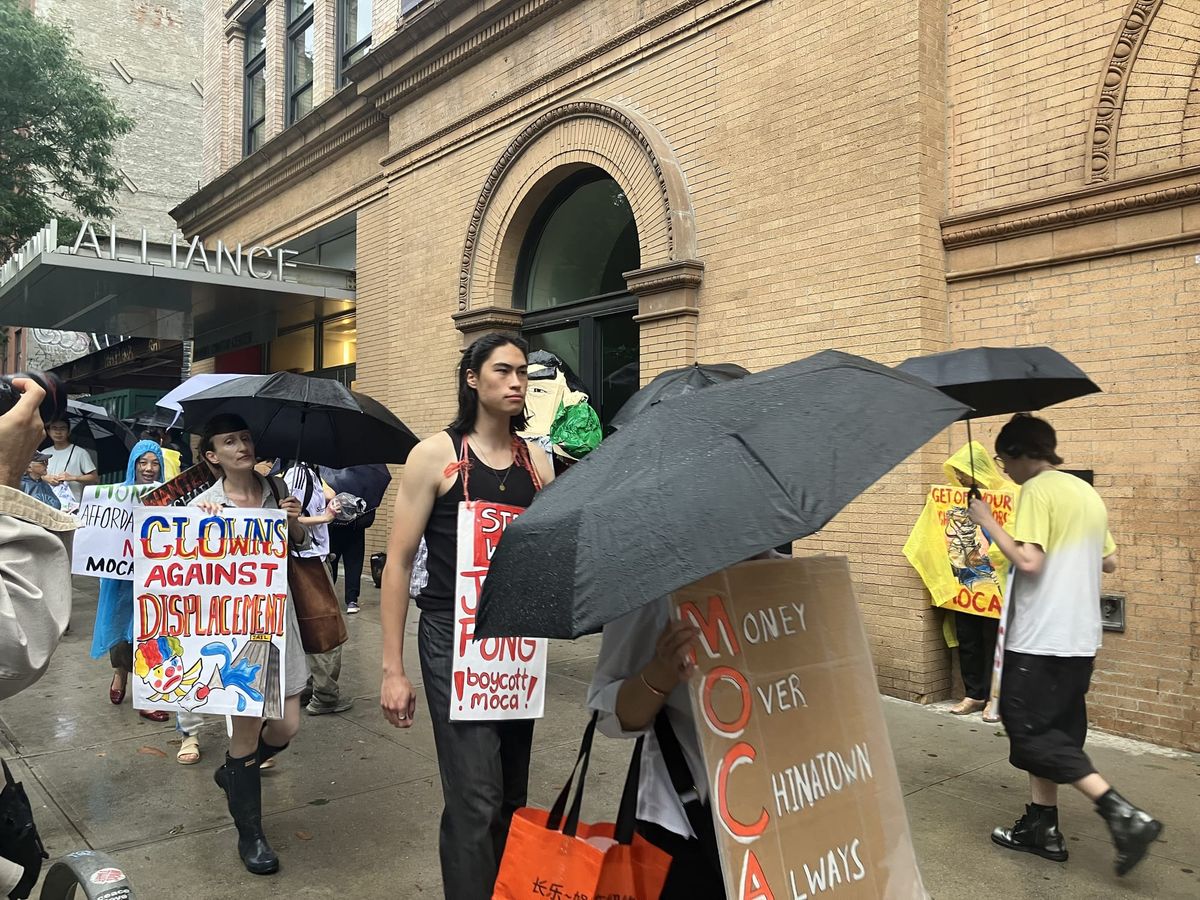
As heavy rain moved into New York City on Tuesday, July 21, demonstrators rallied outside a Lower East Side community center to denounce the MOCA Chinatown jail grant, waving signs that read “Community united against MOCA’s Racism,” “No Jail,” and “You’re Not Fooling Anyone.” Protesters shielded an effigy of Museum of Chinese in America President Michael Lee from the downpour while the museum hosted a town hall inside.
At the Manny Cantor Center, MOCA leadership heard testimony from Chinatown residents and stakeholders. During the event, Lee sought to distance the institution from a $35 million capital grant connected to a planned jail in Chinatown that the museum accepted from the city in 2019. He said the funding was used to buy the Centre Street space MOCA had rented since 2009.
Outside, opponents said the capital award represented acceptance of “jail money” and alleged the museum was complicit in pressures reshaping the neighborhood, including gentrification and displacement. Lee, who became president in 2024, said the museum opposes the jail’s construction and accepted the city funding because it faced the risk of closure and losing its longtime home.
Founded 46 years ago, the museum holds more than 85,000 objects documenting the Chinese American experience. Since taking the grant, however, MOCA has faced sustained criticism, including protests and exhibition withdrawals by artists who argue the institution benefits from mass incarceration.
“MOCA is still supporting the new jail through their actions, despite what they say … they took the money,” said Zi Shun Ning, an organizer with Youth Against Displacement, speaking outside the event.
Debate over the MOCA Chinatown jail grant
Organizers from Youth Against Displacement, Planet Over Profit, and East River Park ACTION arrived early and handed out flyers dubbing the museum’s forum a “clown hall.” While Lee and other leaders cast the funding as necessary for MOCA’s survival, community members argued the money is inseparable from the city’s plan to build the Manhattan Borough-Based Jail.
The facility is slated to be the world’s tallest jail and, along with three other borough jails, would replace Rikers Island under a court order to close the complex due to human rights violations.
Some speakers urged protesters to end their campaign, describing MOCA as a vital home for community history and culture. Asked whether he empathized with the demonstrators and planned to address their concerns, Lee said the museum respected the right to protest and that opponents had every right to fight the jail and view MOCA as a symbol of it.
He encouraged critics to focus their advocacy on relocating the jail.
Lee said the town hall was held at a venue outside the museum to ensure those uncomfortable entering MOCA could participate and noted he personally invited the Chinese Staff and Workers Association and Youth Against Displacement.
During the discussion, protester Aaron Yin challenged the museum’s stance on the $35 million award, asking whether MOCA would acknowledge it as “jail money.” Lee rejected that characterization and said the museum sought the grant solely to purchase its building and remain in Chinatown.
He lamented that the investment coincided with the city’s announcement of the new jail system.
Yin circulated a 2021 report citing a Department of Cultural Affairs statement that the grant was tied to the broader effort to close Rikers Island. Supporters of the museum also spoke, including civil rights attorney Rocky Chin, who said MOCA provides an anchor for family archives and a platform to address contemporary issues such as anti-Asian violence and threats to birthright citizenship.
Some attendees called for reconciliation. Melinda Chiu, whose family has long roots in Manhattan’s Chinatown, urged both sides to resolve their differences while faulting the museum for what she described as a lack of response over the past five years.
She said the jail would be harmful to Chinatown and argued that working together would better address gentrification pressures.
Outside, protesters also pointed to Lee’s volunteer board role at the Chinese-American Planning Council, calling the nonprofit home care organization the “worst sweatshop in New York City.” The Chinese-American Planning Council was named in a 2023 lawsuit by the Legal Aid Society against the state alleging systemic wage theft for home care workers on 24-hour shifts.
During the forum, Lee referred the audience to the organization’s official statements on the case.
Demonstrators additionally criticized former MOCA board member Jonathan Chu, a real estate developer who owned the Elizabeth Street property where the Chinatown restaurant Jing Fong closed during the pandemic.
Some residents voiced broader economic concerns. Liang Chen, a longtime Lower East Side resident, said a jail in Chinatown would deepen the neighborhood’s struggles, noting that business has declined and fewer visitors are spending money in the area.
Pat Arnow, affiliated with East River Park ACTION and part of the Coalition to Protect Chinatown, said protesters wanted a concrete sign from the museum. She said a forceful denunciation of the jail by MOCA could carry weight because the museum holds influence that activists do not.
The controversy over the museum’s role has unfolded as museums worldwide face scrutiny over how they are funded and whose interests they serve.