
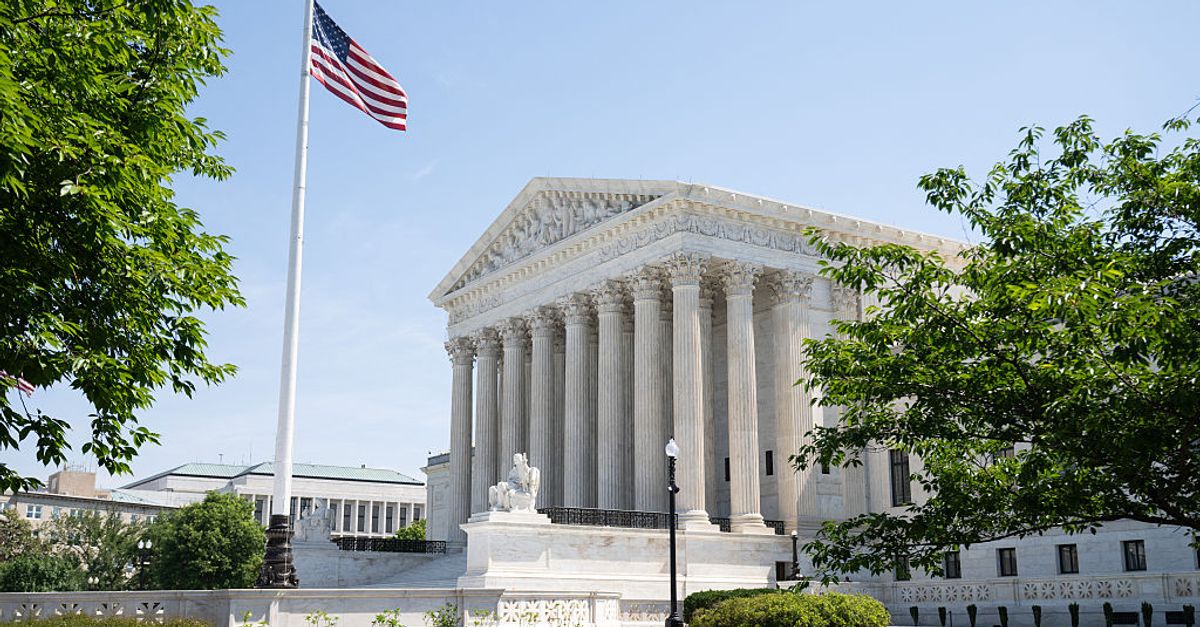
Supreme Court mail-in voting restrictions are at the center of an emergency appeal filed Monday, as the Trump administration asked the justices to permit full enforcement of a March 31 executive order that would tighten rules on absentee and mail-in ballots.
U.S. Solicitor General D. John Sauer urged the Court to lift a Massachusetts federal court injunction that blocked key parts of the directive in 23 states and the District of Columbia. He called the lower court’s action “extraordinary” and said it conflicts with established limits on when courts should step into ongoing executive branch processes.
Supreme Court mail-in voting restrictions appeal seeks swift action
Sauer also requested an immediate administrative stay, which would temporarily pause the injunction while the justices consider the government’s application.
The executive order, titled “Ensuring Citizenship Verification and Integrity in Federal Elections,” instructs the U.S. Postal Service to draft rules governing mail-in and absentee ballots and directs the Department of Homeland Security to create state-by-state “state citizenship lists” of U.S. citizens over 18. Under the order, USPS rules would restrict the Postal Service to sending mail-in ballots only to voters whose names appear on those lists.
A coalition of 23 states and the District of Columbia, led by California, sued in federal court in Massachusetts to stop implementation. They argued the order clashes with constitutional provisions that assign states authority over voter eligibility and the “Times, Places, and Manner” of congressional elections.
U.S. District Judge Indira Talwani agreed. On June 25, she barred the federal government from enforcing the mail-in ballot and state citizenship list provisions for the Nov. 3, 2026, elections in the plaintiff states and the District of Columbia.
On Saturday, a divided panel of the U.S. Court of Appeals for the 1st Circuit declined to intervene. Allowing the order to take effect for this fall’s elections, the majority wrote, would create confusion and risk disenfranchising eligible voters.
Turning to the Supreme Court on Monday, the administration contended the case is not ripe because agencies have not finalized how they will carry out the order. Even if review is appropriate, Sauer argued, the injunction should be stayed to prevent “serious irreparable harm.” He wrote that there is not enough time to obtain ordinary appellate relief and still implement any lawful plans before November, noting election timelines for voter-roll verification and mail voting require earlier action.
The Court directed the states to respond to the government’s request by 4 p.m. EDT on Monday, Aug. 3.
The timing of the filing places the dispute alongside other high-profile matters involving the former president, including a pending Trump petition for reconsideration in the Carroll case that is set for August.