
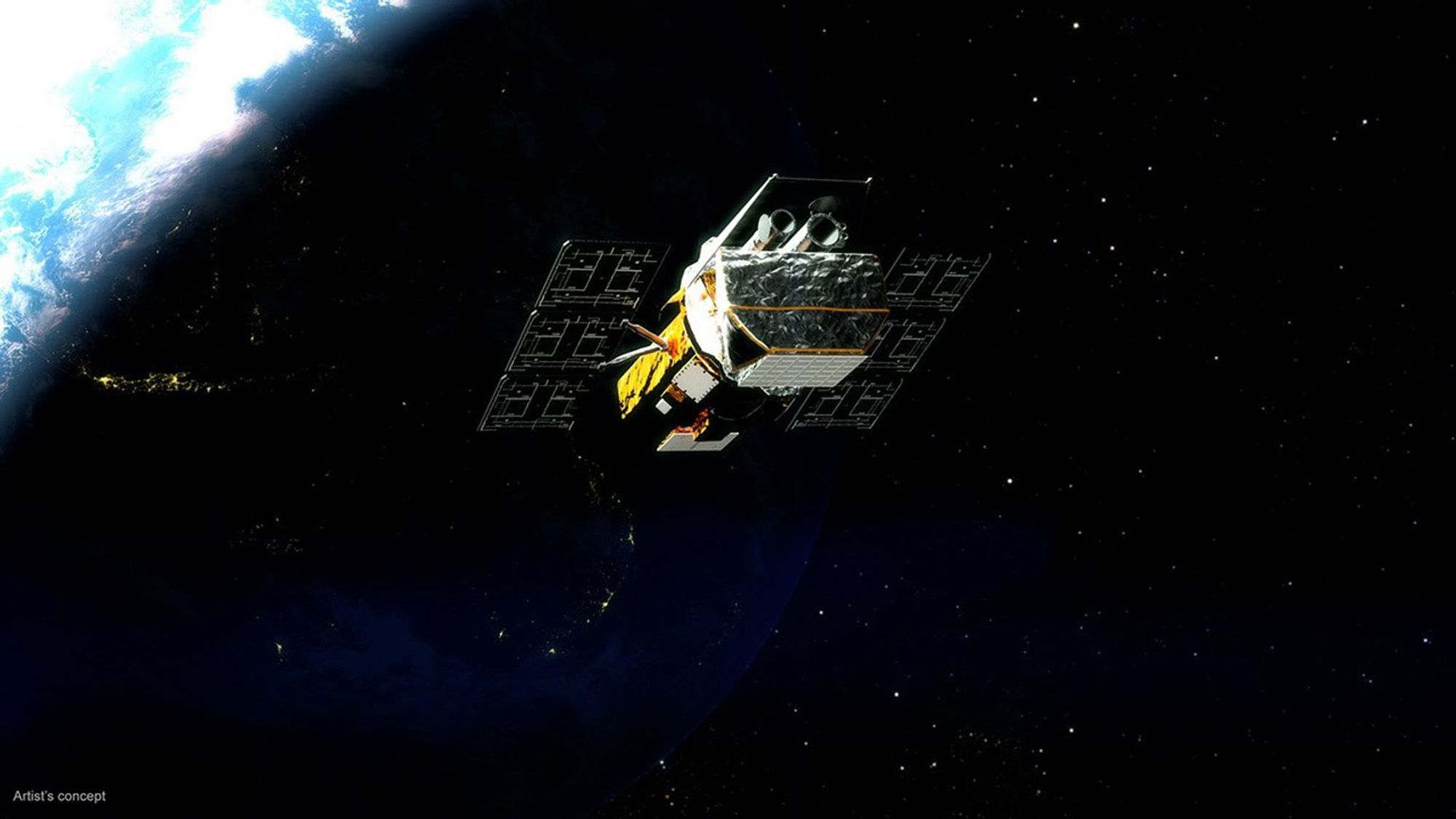
The Swift Observatory rescue faces a new setback after Katalyst Space reported its LINK spacecraft began spinning unexpectedly in the weeks following launch, delaying a planned attempt to boost NASA’s aging telescope’s orbit.
Katalyst’s LINK lifted off July 3 on a Northrop Grumman Pegasus XL launched from a modified Lockheed Martin L-1011 aircraft. Developed in under a year, the $30 million spacecraft was sent to rendezvous with NASA’s nearly 22-year-old Neil Gehrels Swift Observatory before atmospheric drag pulls the telescope down.
Teams at NASA and Katalyst are working to stabilize LINK while Swift’s altitude continues to drop, according to officials. The coming weeks will require balancing preparations for rendezvous against the risk of bringing the spacecraft near Swift too soon. Reentry is projected for the autumn if no intervention occurs.
Swift Observatory rescue timeline shifts
LINK had been expected to meet Swift about a month after launch, but late August is now the earliest feasible date, mission updates indicate. The delay follows electrical power issues that affected two of the three reaction control system wheels used to orient the spacecraft. Only one wheel is functioning normally, leading to unintended rotation.
As of Thursday, engineers had reduced the spin using thruster firings, cutting the rate to about 4 degrees per second from roughly 9, Katalyst said in a mission blog. “Over the last 48 hours, the Katalyst team has worked to reduce LINK’s rotation while assessing current spacecraft functionality and its control system,” the company noted.
NASA administrator Jared Isaacman said there is still a path forward. “We are not giving up yet,” he wrote on X on July 30, calling the effort a low-cost, high-potential mission that advances more autonomous satellite servicing.
Stabilization progress and mission constraints
NASA reported the spacecraft remains power positive and in contact with controllers. If attitude control is restored and the vehicle remains healthy, teams will evaluate revised plans to approach and capture Swift, officials said.
Time pressure is increasing. Swift has scaled back science operations to reduce drag during the summer. Modeling suggests the telescope must remain above roughly 185 miles, or 298 kilometers, for a successful intervention. For context, the International Space Station typically flies near 250 miles, or 400 kilometers.
Why the Swift Observatory rescue matters
Katalyst aims to refuel and reboost Swift, extending the life of a facility now valued at about $450 million in today’s dollars. The mission originally cost $250 million in 2004, far below the approximately $10 billion budget of the James Webb Space Telescope.
Swift was built to detect gamma-ray bursts from cataclysmic stellar events, but it has also contributed to studies of supernovas, X-ray flares, and small bodies such as comets and asteroids. Its continued observations are important, NASA officials have said. S. Bradley Cenko, Swift’s principal investigator at NASA’s Goddard Space Flight Center, described the observatory as a multitool that rapidly responds to fleeting cosmic phenomena and coordinates follow-ups across other facilities.
If the rescue succeeds, Swift could continue work for many years, potentially decades, provided its instruments remain healthy. Similar efforts to understand the high-energy universe include research such as a DIY dark matter antenna revealing the Milky Way’s rotation.