
Iran missile attack on U.S. forces drew a vow of retaliation from President Donald Trump on Wednesday, a day after U.S. Central Command said multiple ballistic missiles launched from Iran were intercepted and as U.S. and Saudi forces carried out joint strikes on Iran-backed militias in Iraq.
Trump told a television reporter that the United States would respond forcefully to Tehran, adding that he had reviewed footage of U.S. air defense crews engaging the incoming missiles in real time and calling out coordinates to ensure none penetrated. He also said back-channel discussions with Iran were ongoing.
Iran missile attack intercepted, U.S.-Saudi response
Central Command said Islamic Revolutionary Guard Corps forces fired multiple ballistic missiles beginning at 5:45 p.m. Eastern Time on Tuesday in what it described as an attempted surprise attack on U.S. personnel in the Middle East. All missiles were intercepted, the command said, adding that U.S. forces remain on heightened alert.
Iranian state media released video it asserted showed an attack on Muwaffaq Salti Air Base in Jordan, a site frequently targeted in the past and where three U.S. soldiers were killed on July 17. National Gazette could not independently verify that footage.
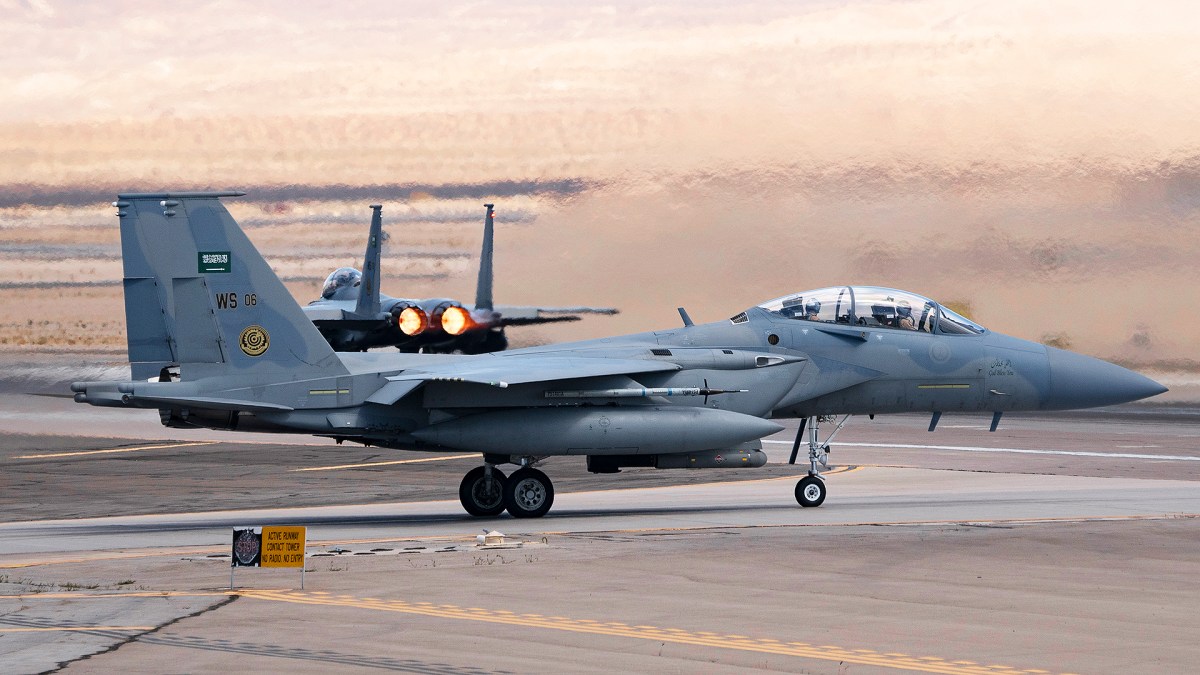
Trump also addressed the overnight U.S.-Saudi air operations in Iraq targeting militias aligned with the IRGC. According to statements relayed by a reporter, he said the strikes were coordinated with the Iraqi government and described the militias as a global threat. Central Command later stated that U.S. and Saudi fighter aircraft conducted precision strikes on logistics and weapons facilities across eastern Iraq in response to more than 30 IRGC-directed drone attacks over 72 hours against U.S. forces and Saudi energy infrastructure. A U.S. official said the joint action followed the Iranian missile barrage and was intended to signal that such attacks will not go unanswered.
Iraqi reactions and calls for restraint
Iraqi militia groups condemned the joint strikes. Harakat al-Nujaba, part of the Popular Mobilization Forces, vowed retaliation and demanded the expulsion of U.S. troops, while the PMF said at least 20 members were killed and 32 wounded in the raids across the country. The group also urged ending cooperation with Saudi Arabia and called for advanced air defenses.
Influential cleric Muqtada al-Sadr urged the IRGC and allied militias not to use Iraqi territory for attacks, warning against actions that could invite strikes from Gulf states. He called on the Iraqi government to assert sovereignty, bolster security, and avoid sectarian escalation.
Operational security concerns for U.S. forces
Amid the exchange, Central Command commander Adm. Brad Cooper warned that service members posting videos and imagery online could aid Iran by revealing outcomes of strikes in near real time, according to a letter reported publicly. He urged a renewed focus on operational security and has weighed restricting the use of personal cellphones. A CENTCOM spokesman said the guidance reflects a priority on protecting more than 50,000 U.S. personnel in the region. U.S. commercial satellite firms have also delayed some imagery releases over similar concerns.
Houthis weigh Red Sea transit fees
Yemen’s Houthi movement is considering charging ships passing through the Bab al-Mandeb Strait, regional sources told reporters, days after the group announced a blockade on Saudi shipping and fired on Saudi vessels. The potential tolls would mirror Iranian efforts to impose fees in the Strait of Hormuz. No timeline was provided. The group did not respond to requests for comment.
Analysts warn that pressure on Bab al-Mandeb, coupled with disruptions around Hormuz, could severely constrain regional oil flows. Saudi Arabia has rerouted millions of barrels per day through pipelines to the Red Sea port of Yanbu, but damage to terminals or pipelines could further curtail exports. Even with Bab al-Mandeb closed, some westbound shipments could transit the Suez Canal, though attacks and tolls could force the United States and partners to divert resources from other operations.
Despite the risks, vessel-tracking firm Kpler reported higher transits on July 28 through both Hormuz and Bab al-Mandeb. The company cautioned that increased volume should not be mistaken for lower risk, citing atypical routing, dark transits, sanctioned vessels, and shadow fleet movements, as well as 62 maritime security incidents recorded by the International Maritime Organization as of July 27.
Munitions stockpiles and recent pause
The latest exchange followed a brief pause after nearly two weeks of tit-for-tat strikes. Trump had not ordered strikes inside Iran since the previous Thursday as diplomacy was explored. Analysts have also highlighted concerns about U.S. air and missile defense inventories. The Center for Strategic and International Studies estimated the United States had about 2,300 Patriot interceptors before the conflict known as Epic Fury, about 1,030 by the April 8 ceasefire, and between 759 and 827 as of July 27. For THAAD, CSIS estimated 452 interceptors pre-war, between 232 and 262 at the ceasefire, and between 234 and 278 on July 27, reflecting deliveries during the pause. The report noted additional PAC-2 stocks not represented in the charted figures.
With Trump signaling a response to the ballistic missile attack, those stockpile concerns may be overtaken by operational demands in the near term.
Update: drone strikes at Egypt’s Damietta port
Two liquefied natural gas vessels were hit by drones at Egypt’s Damietta port, maritime security firm Ambrey reported. A U.S.-owned and operated, Marshall Islands-flagged floating storage and regasification unit and a Greek-owned and operated, Bermuda-flagged LNG tanker were struck during discharge operations, Ambrey said, causing a fire aboard the storage vessel and prompting crew evacuations. The blaze was brought under control and no casualties, port damage, or pollution were reported. The tanker subsequently anchored offshore. A maritime security specialist identified the vessels as the Energos Winter and GasLog Salem. No group claimed responsibility at the time of reporting. Satellite fire detection data showed thermal anomalies inside the port near the berths, and videos circulating online appeared to show smoke from the scene. National Gazette could not independently confirm the attack claims.
In energy markets, Brent crude rose toward 90 dollars per barrel, rebounding from just over 83 dollars the prior day when the lull in hostilities was holding.
The U.S. Central Command statements on the missile attacks and subsequent strikes continued to drive diplomatic and military responses across the region. As the United States evaluates longer-term defense and deterrence options, initiatives such as the Pentagon GBAM challenge are drawing attention to the need for cheaper long-range strike capabilities.