
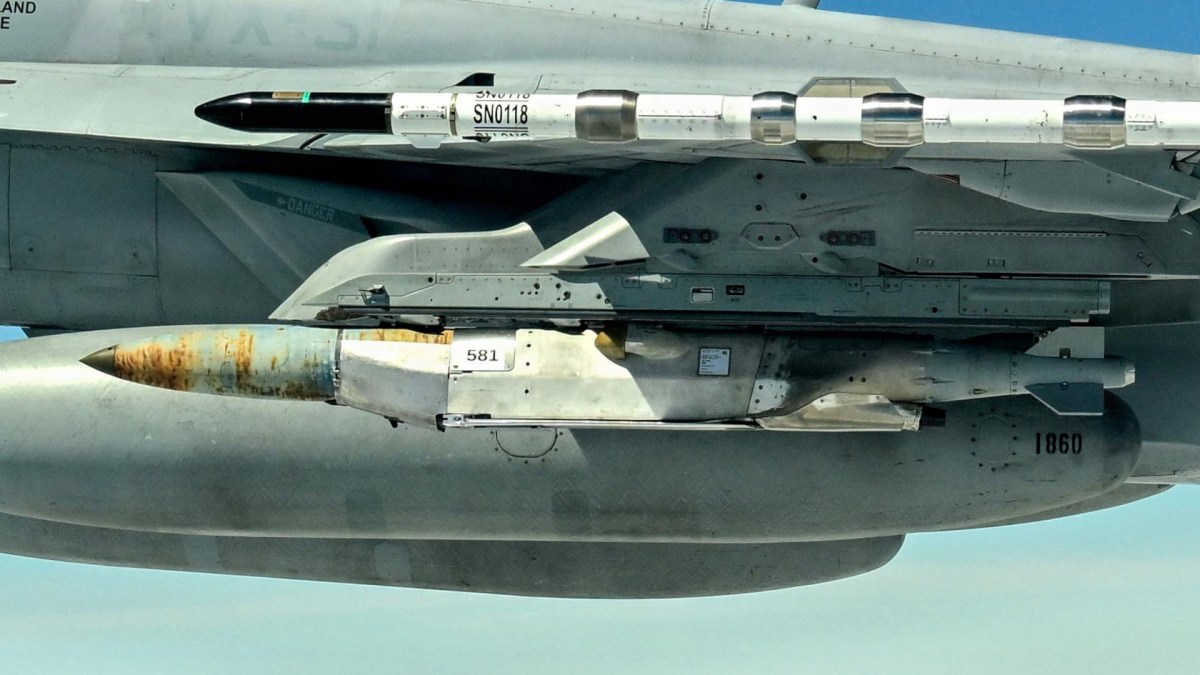
JDAM-LR production is moving ahead after Boeing received initial funding to build the U.S. Navy’s new long-range, precision-guided weapon based on the Joint Direct Attack Munition family. The company’s announcement follows successful Navy test launches of JDAM-LR from F/A-18E/F Super Hornets in April, offering a new option to expand stocks of air-launched standoff munitions.
According to Boeing, the company has been awarded a $75 million Undefinitized Contract Action from the U.S. Air Force, which manages the joint-service JDAM program, to support JDAM-LR production for the Navy. A UCA allows work to begin while final terms, including pricing, are still being negotiated, a tool often used to meet urgent needs.
“This first production contract is a major milestone for the JDAM LR program,” Bob Ciesla, Boeing’s vice president for Precision Engagement Systems, said in a statement, adding that scaling production of the GBU-75 would provide an affordable and sustainable long-range precision-strike option for U.S. and international forces.
The complete JDAM-LR round carries the designation GBU-75/B. Boeing also disclosed that the core module, called the Payload Delivery Unit, is designated BSU-111/B.
Like the original JDAM, JDAM-LR is a kit rather than a standalone munition. The PDU integrates the guidance section, aircraft interface, a deployable wing set, and a compact turbojet understood to be the TDI-J85. This module mates with a standard low-drag 500-pound-class bomb body to form the full weapon.
JDAM-LR production builds on modular JDAM design
The modular approach, familiar from 500-, 1,000-, and 2,000-pound JDAM variants, allows flexible configurations. Boeing has previously illustrated powered JDAM concepts paired with general-purpose bombs and Quickstrike-series shallow-water naval mines.
Numerous 500-pound-class warheads share the same form factor, including designs intended to limit collateral damage. The company already offers a 500-pound JDAM variant with a laser seeker for moving targets.
For guidance, JDAM-LR uses the GPS-assisted inertial navigation common to unpowered JDAMs, which is designed for fixed-coordinate targets. Boeing has shown concepts for multi-mode seekers, such as radar or imaging infrared, that could enable engagements against moving targets at sea and on land.
The powered configuration’s chief advantage is reach. Boeing says JDAM-LR can strike from beyond 345 miles, or roughly 300 nautical miles.
By comparison, a typical unpowered JDAM can glide about 15 miles after release, and a JDAM-Extended Range with a pop-out wing kit can reach around 45 miles, depending on altitude and launch speed.
Leveraging mature JDAM components is expected to help control costs and support rapid scaling. Boeing says it has invested nearly $100 million of its own funds in the effort, which dates back at least to the late 2010s.
While the precise unit price for a JDAM-LR remains unknown, historical figures for standard JDAM kits fall between $20,000 and $30,000. The current price for the TDI-J85 engine has not been disclosed.
For context, previous reports have cited around $190,000 for the larger Williams F107 turbojet used in other cruise missiles, with a 500-pound low-drag bomb body adding several thousand dollars more.
For the Navy, the JDAM-LR provides a lower-cost and lower-risk path to expand the carrier air wing’s standoff strike inventory. The service canceled a planned turbojet-powered variant of the AGM-154 JSOW glide bomb in 2021 in favor of the AGM-158C Long-Range Anti-Ship Missile with secondary land-attack capability, and in 2024 said it would drop land-attack functionality from the AGM-158C-3.
LRASM is highly capable but typically costs about $3 million per round. Navy air wings also field the AGM-84K SLAM-ER, an air-launched land-attack derivative of the Harpoon with a reported range of around 170 miles.
SLAM-ER unit costs are likewise in the $3 million range. Extending the reach of carrier-based aircraft remains a priority as adversaries, particularly China, expand anti-access and area denial networks that push carriers farther from targets and complicate operations.
Greater standoff range also reduces exposure of launch platforms to advanced air defenses. Recent conflict with Iran, following years of crises in the Middle East and beyond, has further highlighted the strain on munitions stockpiles and the challenges of rapid replenishment.
U.S. forces are taking steps to rebuild inventories, but meaningful gains will take time. Capabilities such as JDAM-LR provide additional avenues to refill standoff weapon stocks at scale and at lower cost.
Given these factors, procurement of JDAM-LR could broaden beyond the Navy. The Air Force, as JDAM program manager, is placing orders, and allies with existing JDAM inventories could participate, improving economies of scale.
After years of development and recent flight tests, Boeing is now set to deliver JDAM-LR to the fleet under the Navy’s initial orders.
JDAM-LR production is moving ahead after Boeing received initial funding to build the U.S. Navy’s new long-range, precision-guided weapon based on the Joint Direct Attack Munition family. The company’s announcement follows successful Navy test launches of JDAM-LR from F/A-18E/F Super Hornets in April, offering a new option to expand stocks of air-launched standoff munitions.
According to Boeing, the company has been awarded a $75 million Undefinitized Contract Action from the U.S. Air Force, which manages the joint-service JDAM program, to support JDAM-LR production for the Navy. A UCA allows work to begin while final terms, including pricing, are still being negotiated, a tool often used to meet urgent needs.
“This first production contract is a major milestone for the JDAM LR program,” Bob Ciesla, Boeing’s vice president for Precision Engagement Systems, said in a statement, adding that scaling production of the GBU-75 would provide an affordable and sustainable long-range precision-strike option for U.S. and international forces.
The complete JDAM-LR round carries the designation GBU-75/B. Boeing also disclosed that the core module, called the Payload Delivery Unit, is designated BSU-111/B.
Like the original JDAM, JDAM-LR is a kit rather than a standalone munition. The PDU integrates the guidance section, aircraft interface, a deployable wing set, and a compact turbojet understood to be the TDI-J85. This module mates with a standard low-drag 500-pound-class bomb body to form the full weapon.
JDAM-LR production builds on modular JDAM design
The modular approach, familiar from 500-, 1,000-, and 2,000-pound JDAM variants, allows flexible configurations. Boeing has previously illustrated powered JDAM concepts paired with general-purpose bombs and Quickstrike-series shallow-water naval mines.
Numerous 500-pound-class warheads share the same form factor, including designs intended to limit collateral damage. The company already offers a 500-pound JDAM variant with a laser seeker for moving targets.
For guidance, JDAM-LR uses the GPS-assisted inertial navigation common to unpowered JDAMs, which is designed for fixed-coordinate targets. Boeing has shown concepts for multi-mode seekers, such as radar or imaging infrared, that could enable engagements against moving targets at sea and on land.
The powered configuration’s chief advantage is reach. Boeing says JDAM-LR can strike from beyond 345 miles, or roughly 300 nautical miles.
By comparison, a typical unpowered JDAM can glide about 15 miles after release, and a JDAM-Extended Range with a pop-out wing kit can reach around 45 miles, depending on altitude and launch speed.
Leveraging mature JDAM components is expected to help control costs and support rapid scaling. Boeing says it has invested nearly $100 million of its own funds in the effort, which dates back at least to the late 2010s.
While the precise unit price for a JDAM-LR remains unknown, historical figures for standard JDAM kits fall between $20,000 and $30,000. The current price for the TDI-J85 engine has not been disclosed.
For context, previous reports have cited around $190,000 for the larger Williams F107 turbojet used in other cruise missiles, with a 500-pound low-drag bomb body adding several thousand dollars more.
For the Navy, the JDAM-LR provides a lower-cost and lower-risk path to expand the carrier air wing’s standoff strike inventory. The service canceled a planned turbojet-powered variant of the AGM-154 JSOW glide bomb in 2021 in favor of the AGM-158C Long-Range Anti-Ship Missile with secondary land-attack capability, and in 2024 said it would drop land-attack functionality from the AGM-158C-3.
LRASM is highly capable but typically costs about $3 million per round. Navy air wings also field the AGM-84K SLAM-ER, an air-launched land-attack derivative of the Harpoon with a reported range of around 170 miles.
SLAM-ER unit costs are likewise in the $3 million range. Extending the reach of carrier-based aircraft remains a priority as adversaries, particularly China, expand anti-access and area denial networks that push carriers farther from targets and complicate operations.
Greater standoff range also reduces exposure of launch platforms to advanced air defenses. Recent conflict with Iran, following years of crises in the Middle East and beyond, has further highlighted the strain on munitions stockpiles and the challenges of rapid replenishment.
U.S. forces are taking steps to rebuild inventories, but meaningful gains will take time. Capabilities such as JDAM-LR provide additional avenues to refill standoff weapon stocks at scale and at lower cost.
Given these factors, procurement of JDAM-LR could broaden beyond the Navy. The Air Force, as JDAM program manager, is placing orders, and allies with existing JDAM inventories could participate, improving economies of scale.
After years of development and recent flight tests, Boeing is now set to deliver JDAM-LR to the fleet under the Navy’s initial orders.