
The Smithsonian hearing before the House Committee on Oversight and Government Reform last week turned into a spectacle, with National Museum of American History Director Anthea Hartig fielding provocative questions in a session that Republicans framed as a response to a July White House report alleging the Smithsonian Institution promotes “extreme political activism.” The Smithsonian hearing quickly produced a string of viral exchanges, often cutting off Hartig before she could respond.
The session followed weeks of criticism from the Trump administration, which has threatened the Smithsonian’s funding while seeking internal texts, staffing details, and programming plans across its museums and research centers for review. The July report singled out Hartig by name, and former National Portrait Gallery Director Kim Sajet has also drawn direct attacks from President Trump, who said in 2025 that he dismissed her over efforts to diversify programming and acquisitions.
Smithsonian hearing under partisan scrutiny
Hartig, the first woman to lead the National Museum of American History since her appointment in 2019, faced a barrage that included the following questions:
- Are you sexualizing children?
- Do you believe men can become women?
- What is a woman?
- When was your gender revealed to you?
- Do you think it is the goal of the Smithsonian Institution to promote White supremacy culture?
- Is Mickey Mouse racist?
- Is it important to be polite?
- What is “Latina power?”
- Do you think it is appropriate for the Smithsonian Institution to sell Latina power paraphernalia?
- What about the tens of millions of aborted babies killed in America — where is the justice and compassion for them?
The Smithsonian Institution oversees 21 museums and the National Zoo in Washington, D.C., and is among the most prominent cultural organizations in the world. Its official site at si.edu outlines its collections, research, and public programming.
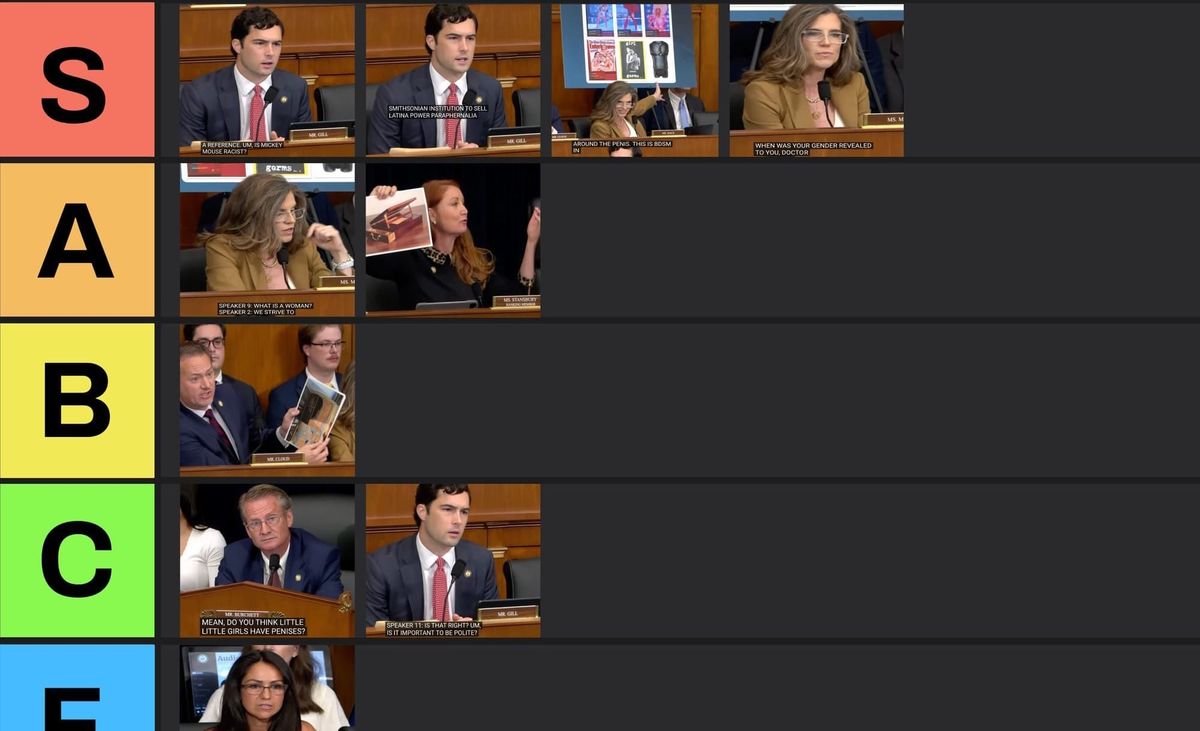
The exchanges from the July 21 hearing ranged widely in tone and topic. For clarity, the most consequential and unusual questions were grouped into tiers based on impact. Texas Republican Brandon Gill drew attention with a line of inquiry asking, “Is Mickey Mouse racist?” and later pressing on the meaning of “Latina power,” which Hartig defined as “the forces derived from being a Latina.”
South Carolina Republican Nancy Mace focused on an industrial-looking metal and rubber harness in the museum’s holdings, saying her staff identified “this little trinket around the penis” as “BDSM.” She also repeatedly challenged Hartig on the definition of a woman and accused the museum of sexualizing children.
Subcommittee chairman Tim Burchett of Tennessee asked Hartig to identify what genitalia little girls have. That exchange was assessed in the lower tier given its uncomfortable tone and repetition of earlier themes. Colorado Republican Lauren Boebert sharply criticized what she described as the museum’s omission of “tens of millions of aborted babies who were killed in America,” a point that was rated least relevant to the National Museum of American History’s mission during the ranking.
Despite the tenor of the questions, Hartig remained measured and avoided sparring. Moments of pushback and clarification emerged at intervals from Democratic members, cutting through debates over cross-dressing, display protocols for Abraham Lincoln’s top hat and Thomas Jefferson’s writing desk, and declarations about patriotism.
New Mexico Democrat Melanie Stansbury, the subcommittee’s ranking member, noted that Jefferson’s desk has been displayed in a special semiquincentennial exhibition curated by Smithsonian Secretary Lonnie Bunch II. Virginia Democrat James Walkinshaw criticized the Trump administration’s own record on historical representation, pointing to the removal of online profiles for Jackie Robinson, the Tuskegee Airmen, and Navajo code talkers from a Defense Department website following an executive order dismantling federal Diversity, Equity, and Inclusion initiatives.
The political clash over museum stewardship and representation echoes broader debates over cultural institutions, including controversies around looted artworks and restitution such as those explored in French museum’s ‘Wanted’ drive seeks looted artworks. At the outset, Hartig offered a succinct description of the museum’s guiding approach: “Patriotism. Not instructed, but inspired.”