
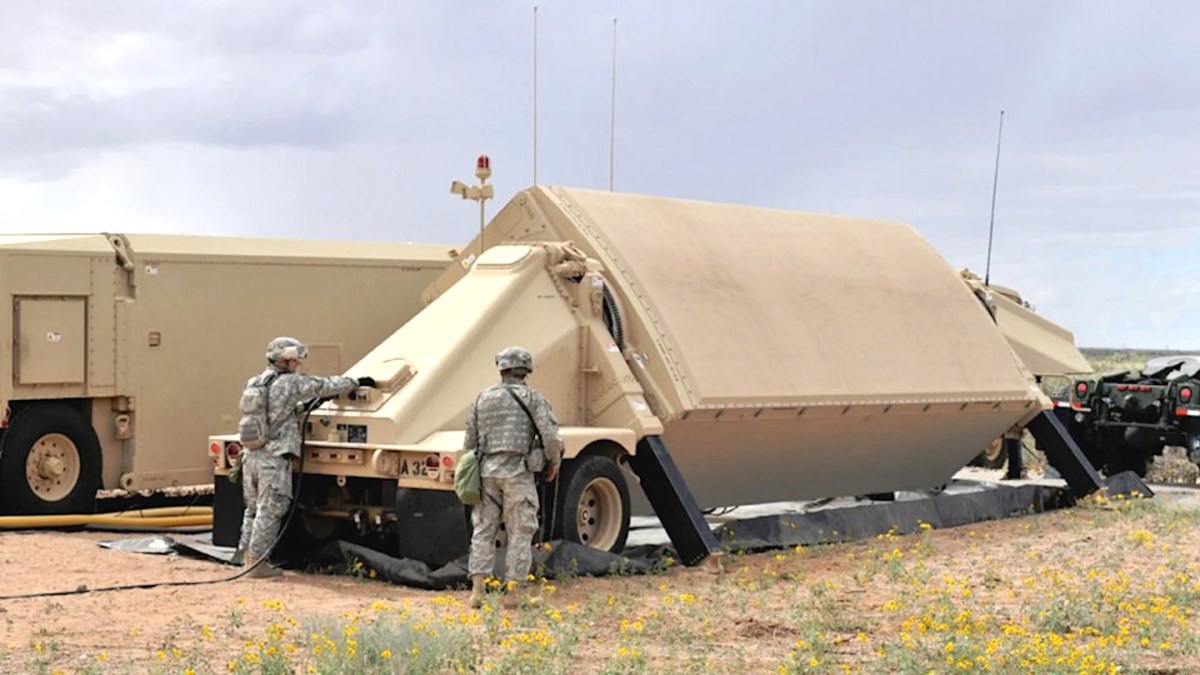
The U.S. Missile Defense Agency is advancing plans for a new forward-deployed sensor known as FBM Radar Next, a more mobile successor to the AN/TPY-2, following Iran’s successful strikes on largely fixed radar sites earlier this year. FBM Radar Next is intended to cut the risk of destruction from missiles and drones by enabling rapid movement and dispersed operations.
MDA issued a request for innovative prototype concepts for FBM Radar Next on the eve of the Space & Missile Defense Symposium in Huntsville, Alabama. Officials emphasized the effort remains in pre-solicitation, with prototypes expected to be pursued under an Other Transaction Authority to speed development. The agency’s Fiscal Year 2027 budget request seeks funding for two next-generation radar prototypes to mature technologies for a future fleet.
FBM Radar Next requirements
Forward-Based Mode refers to sensors that detect missile threats shortly after launch. Systems like AN/TPY-2 used in this role are typically installed at semi-permanent locations and complemented by fixed strategic radars and space-based assets for early warning. AN/TPY-2 can also operate in terminal mode, cueing interceptors for systems such as THAAD and providing data to Patriot batteries.
The U.S. military is publicly known to operate two AN/TPY-2s in FBM mode in Japan, with additional sites in Israel, Qatar, and Turkey. Other AN/TPY-2s are forward-deployed as part of THAAD. Although trailer-mounted and technically road-mobile, these units are not designed for rapid relocation, a shortfall MDA aims to address with FBM Radar Next.
According to the notice, the new radar must be agile, survivable, and precise, with fast transport and deployment via C-17 and tactical ground vehicles. The agency wants operational setup within specified hours of arrival and the ability to tear down within minutes to maximize survivability.
Performance goals include high-sensitivity detection, persistent tracking, and accurate discrimination in cluttered and contested electromagnetic environments. MDA also calls for engineered physical, thermal, and electromagnetic signatures to enhance survivability, as well as remote operation, integration with command and control, and automated health monitoring to minimize on-site personnel.
The concept envisions modular, open architectures that can operate as a single aperture or as distributed arrays to optimize coverage, sensitivity, survivability, and electronic protection. Seamless compatibility with the Command and Control, Battle Management, and Communications architecture is required.
Distributed designs and industrial scalability
A distributed approach could allow multiple smaller radars to replace a single large unit. Smaller nodes may be easier to conceal, generate lower signatures, and relocate more readily, improving resilience if individual nodes are lost. This model could also reduce unit cost and speed production.
Raytheon, the prime contractor for AN/TPY-2, is understood to have built 16 units for all customers. Individual radars are generally estimated at roughly 250 to 300 million dollars and require long lead times. MDA’s notice stresses design-for-manufacturing-and-assembly, affordability, and a clear path to rapid, high-volume production to replenish units in active forward environments.
Lessons from recent conflicts
The push for FBM Radar Next is driven by real-world threats, not only from missiles but also from long-range one-way attack drones. Strikes in the Middle East earlier this year reportedly damaged prized air and missile defense radars, reinforcing the vulnerability of static systems and the need for mobility. The risks extend beyond any single theater.
In a panel at the SMD Symposium, U.S. Army Lt. Gen. Richard Zellmann, Deputy Commander of U.S. Space Command, highlighted how one-way attack systems are being paired with missile salvos and enabled by widely available space-based imagery, navigation, and communications. He noted that commercial space services have created a more transparent battlefield, allowing adversaries to combine commercial ISR with GPS or other PNT systems and commercial satellite communications to build asymmetric strike capabilities.
Because GPS-guided munitions are most effective against fixed targets, transportability and rapid repositioning are central to FBM Radar Next’s survivability goals. At the same time, the radar will remain one layer within a broader air and missile defense enterprise. Recent attacks have renewed arguments for additional protective layers around high-value sensors and for migrating more early warning and tracking capabilities into orbit. As threats to space systems also increase, a redundant blend of terrestrial and space-based sensing will be critical.
What ultimately replaces AN/TPY-2 remains to be determined. For now, the Missile Defense Agency is recalibrating how forward-based missile defense radars must be designed and employed so they can endure in an era of proliferating missiles and weaponized drones.