
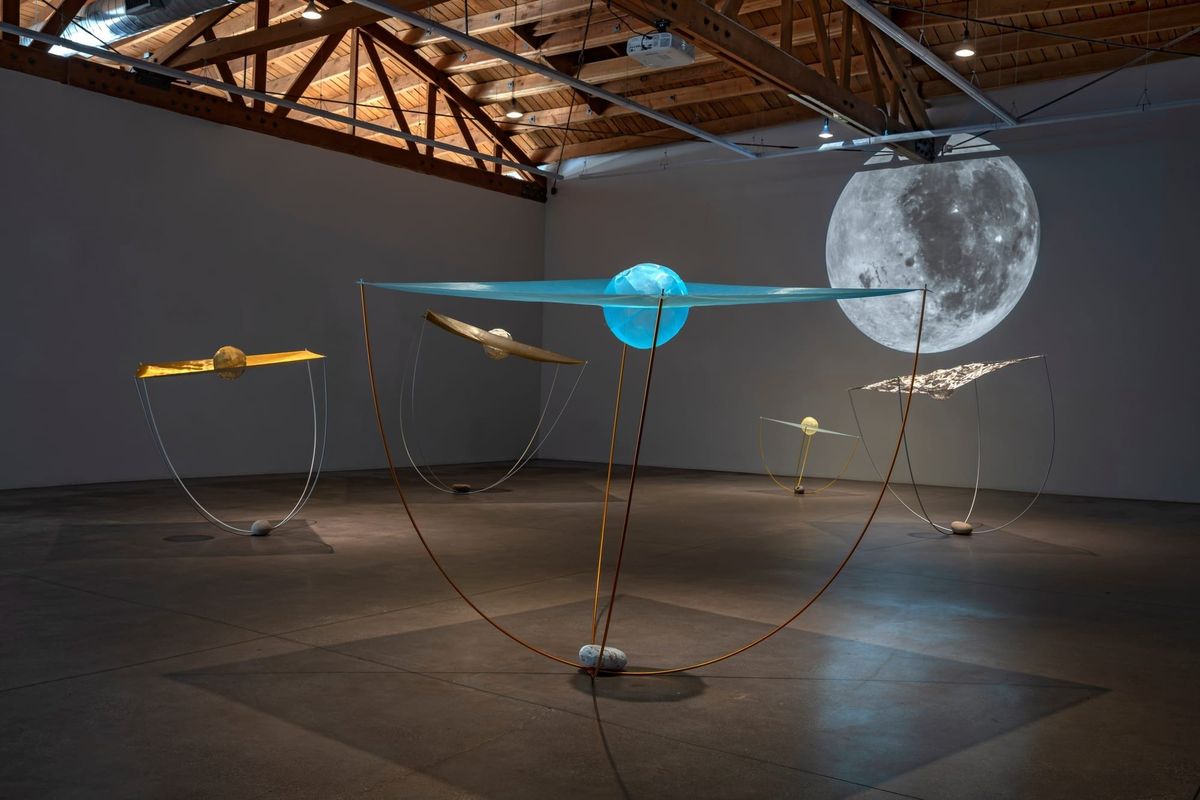
The Universe Breathes Us is the latest project from Relational, the working name adopted by sculptor Shirley Tse and filmmaker Dana Berman Duff. First presented in 2025 at Kling and Bang in Reykjavik after an invitation from artist Anna Hrund Másdóttir, the exhibition appeared again this summer at Shoshana Wayne Gallery in Los Angeles, where it unfolded as an intricate dialogue between sculpture, moving image and sound. Geography, landscape, desire and time converge as the artists trace how breath, the moon and tides connect bodies to the wider cosmos.
The Universe Breathes Us returns in Los Angeles
Both iterations included a live choral performance of an original song by Berman Duff and her husband, composer-musician Alan Duff Berman. The installation’s components appear spare yet interdependent. In Tse’s photograph Orkney Moon (2025), a rice paper–covered soccer ball rests in a summer field on a Scottish island, an everyday object recast as a lunar body. That moon form moves through a suite of sculptures occupying the main gallery, framed by Berman Duff’s projections on opposing walls. In The Other Side of the Moon Is Not Dark (2025), a large projected moon turns almost imperceptibly. In The Breathing Ocean (Portal) (2026), that image meets footage of the original Icelandic choir, which flickers and drifts like aurora.
In an adjoining space, film and sculpture meet in Sun and Moon (2025). Tse’s suspended rice paper moon, hung by a single thread, catches and throws shifting shadows from Berman Duff’s 16mm projector. At the end of the reel, the loose film tail beats a steady flap, a small but insistent rhythm in the room.
Relational practice and lunar power
Speaking at the Los Angeles gallery, the artists described Relational as a nontraditional collaboration in which each makes autonomous works that respond to the other. Tse traced the project to research on tidal turbine power during a 2024 residency in Scotland. She was drawn to the idea that tides are driven by lunar gravity and that tidal energy is, as she put it, power harnessed from the moon. That discovery shifted her focus from engineering toward the poetic and physical ties among celestial bodies. She linked those ideas to a passage in Yoga Anatomy that reframes breathing as the atmosphere pushing air into the body, a view that upends subject and object and anchors the exhibition’s interest in relational forces.
Berman Duff, who moved from sculpture to film to work more directly with time, said her approach is rooted in structure and impermanence. For the slowly rotating moon projection, she scaled the real moon to the wall image, then mapped its 29.5-day rotation to the installation, landing on a cycle of two hours and 40 minutes. The barely perceptible movement aligns with her broader 16mm practice.
Breath, balance and fragile forms
Breath operates as the show’s through line. Tse’s Bobbing Moon sculptures extend the Orkney Moon sphere into mesh fields where the orbs seem to hover between tilt and counterweight. The works are static but imply motion, balanced by stones and light structural elements. Tse emphasized fragility as a reflection of the life-world’s precarity and noted that her materials are repurposed from her studio, including tent poles that allow the works to collapse for storage and transport.
The artists also set aside individual authorship for this project. All works are credited to Relational, a decision Berman Duff said reflects how each piece exists because of the other’s thinking, even when made separately.
Sound as image and tide
Sound shapes the installation’s pacing and sense of time. Visitors hear breathing that subtly influences how they move through the space. At Tse’s urging, the soundscape widens to the ocean, weaving in surf and the abrasive grind of underwater energy-collection turbines. Berman Duff described the inclusion of that mechanical noise as an ethical choice. A short composition by Alan Duff Berman adds a calming register before the choir returns.
‘Sun and Moon’ and an object that became an event
In Sun and Moon, Berman Duff sought to pair a sun with Tse’s moon and to conjure a faintly apocalyptic note with the anxious rhythm of a projector running out of film. The repeated flap signals an ending that never quite arrives.
Tse described Orkney Moon as a work that made itself. The rice paper skin, once removed from the football for conservation by a niece, became a drawing. Kicked across grass by a nephew, it took on stains of chlorophyll and soil, a record of motion and place. To extend the piece beyond a static object, the artists compiled an exhibition notebook of emails, calculations and reflections. The publication situates the project in both physical and literary space, offering context for how The Universe Breathes Us gathers breath, lunar pull and human collaboration into a single, quietly resonant system.